Showing posts with label Wool dog. Show all posts

Saturday, December 17, 2011

Coast Salish Blankets - a Mass Spec Update

[Photo: Salish robe, 1838-1842, Wilkes Expedition,
from the Smithsonian collection, #E2124-0]
Big news in the Coast Salish weaving world. Researchers from York University analyzed nine Salish textiles (blankets, trump lines) at the Smithsonian to try to determine what fibres were used. They used a mass spectometry technique (a way to identify molecules by their mass) to solve the question 'is there dog hair in the blankets?'  
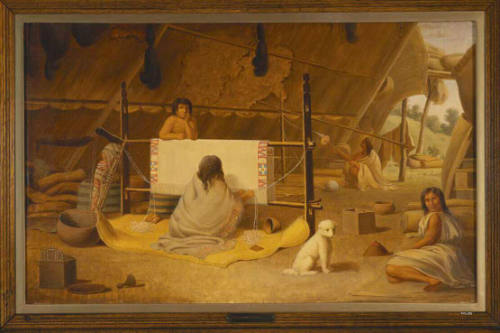
This question has been nagging at those interested in these blankets for a long time. It is a weird question. We have Coast Salish oral history telling us this is so. We have written logs/diaries by early explorers like Capt. Vancouver, also saying dog wool was used. We have artists who wrote and even painted what was probably a wool dog (Paul Kane). But we still want 'proof'. Interesting that 'proof' has a hierarchy, which I suspect goes something like this: artwork somewhere at the bottom, then oral history, written diaries and logs, official documents, and then there is scientific 'proof' at the top. And even scientific proof has hierarchies depending on what is trying to be proven.  'Proof' has layers. One layer of proof builds upon another until you have the full story of the 'ultimate truth'. Different layers take a weak proof like a myth and builds onto it. Each layer builds more certainty in the proof. Add more layers, and the myth solidifies until you have an irrefutable fact. More proof makes it more solid, like a textile.
[Photo: Salish robe, from the
 Smithsonian collection,E1891-A]
With the wool dog fibre, the proof story goes something like this:

  1. Oral history tells of the wool dog and it's wool being used in blankets and robes..
  2. Early explorers (Capt. Vancouver) records the use of dog wool in textiles.
  3. Early artists (Paul Kane) painted a dog that could be a wool dog and wrote of wool dogs, but artists license means this in not 'proof that the dog existed or looked like what Paul Kane sketched or painted'.
  4. Eye-balling the fibre in Salish blankets show at least two different fibres, but many animals, like the Mtn Goat have an outer coat and a downy coat. So even if there are two different types of fibre, it doesn't prove that they belong to two different animals.
  5. Scanning electron microscope (SEM) was used to look at fibre magnified to see differences, but it wasn't reliable for fibres that are very old as fibres can wear. A new fibre will easily show the scales on the outside but old fibres rub and wear down those scales, so it isn't conclusive when looking at the outside of the fibre. And even if the old fibre was in really good shape, we need a wool dog fibre as the baseline to compare with. How can we identify a wool dog fibre if we don't know what one looked like in the first place? No wool dog, no proof.
  6. Carbon isotope analysis - This research showed that some fibres came from an animal that ate a diet of marine food. Wool dogs were fed salmon, but carbon isotope analysis can only prove that the animal did eat marine food but can not 'prove' that the marine food was salmon, nor that animal eating the marine food is a dog. See this blog for more info.
  7. 1997, Osteometry (analyzing the bones) showed that there were two species of dog in the Pacific Northwest coast. This helped prove that there was intentional breeding to keep the two species apart. Why would they want to? There must have been a benefit in keeping the breeds pure, but what that reason was we can only surmise it was for the wool of one of the species. A forensic artist used the bones to sketch out what the dog could look like and there is a resemblance to the Paul Kane sketch and painting. But that doesn't prove it.
  8. Scanning electron microscope (SEM) analysis - split hairs. Someone came up with the idea that if SEM wasn't reliable for old worn fibres, then what about the inside of the fibre? Split the hair and then magnify it. Lo and behold, it turns out that the inner hair tells a lot and is very useful for telling fibres apart. But, you still need to know what a wool dog fibre looks like in the first place.
  9. Then, in 2006 in a dusty drawer somewhere in the Smithsonian, someone finds Mutton, a wool dog' or at least what is left of Mutton -- his pelt, which had been donated to the museum sometime. We now have a wool dog fibre! We have the baseline to compare old robes and blankets with.
  10. Back to SEM and now we can compare a Mtn Goat fibre with a wool dog fibre. Check out the picture in this blog posting.
  11. DNA analysis has been used to identify DNA in a Salish Blanket as being from a dog. Other blankets showed DNA from a Mtn. Goat. So DNA can be used to identify fibres in textiles. We are still waiting to hear more about this ongoing research at the Smithsonian.
  12. Mass spectometry - identifies dog hair in the textiles and this is the research that was recently announced.
Yes, there now seems to be 'scientific proof that dog hair was used in some Salish blankets. Or put another way, there is now 'scientific proof' that what people said, saw and wrote about did indeed exist. And, we now have a host of techniques that can be used to help identify dog hair being used in blankets.
Click here to see all my posts on the wool dog and Salish blankets.
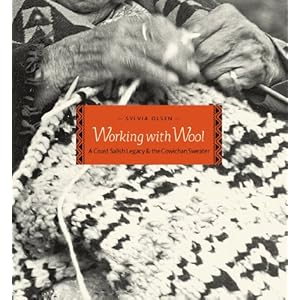
Here are a couple of books you might be interested in: 
Working with Wool, a Coast Salish Legacy . Although it looks at the history of the Cowichan Sweaters, it covers the history of the wool too.
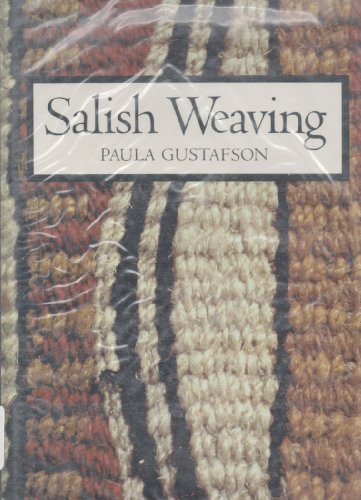
And Paula Gustafson's Salish Weaving . Although it is out-of-print, it is currently the best book available on the history of Coast Salish weaving. I am awaiting eagerly Leslie Tupper's book which I believe should be close to being available.


Thursday, April 7, 2011

The Coast Salish Spindle

[Photo: Coast Salish whorls at the
Royal BC Museum]
I have been spending some time investigating the Coast Salish Spindle with the idea of having a friend make me one and thought I would share some of what I have found. 


The Coast Salish spindle was used mainly by the Coast Salish of Vancouver Island (e.g. Snuneymuxw , Quwutsun, Tsartlip) and the mainland Coast Salish (e.g. Musqueam, Yale, Spuzzum). The Coast Salish Spindle is distinguished from other spindles, not only due to its size: the spindle shaft usually measures 90-120 cms (35-48”) and the whorl is commonly 18-20 cms (7-8”), but also due to its method of use –tossing into the air (more on this in a later blog...once I have had a chance to figure out how that worked).

The whorl, often made from Maple wood (have you ever seen those beautiful Maple trees in Cowichan Bay?), is placed either midway up the shaft or between half-way and two thirds down the shaft. The shaft is tapered with the larger end at the bottom. The whorl is often decorated by incised carving on one side of the whorl, the side facing down towards the spinner. The upper side of the whorl is sometimes flat or slightly concave. On many whorls the center shaft hole is thicker than the surrounding wood, tapering down to a thinner outer edge of the whorl.

[Photo: Salish spindle on display at
the Royal BC Museum]
The Salish spindle was used for spinning goat wool mixed with dog hair from the Salish Wool Dog. The yarn created was a thick yarn used for blankets. Later the spindle was used for yarns used in the Cowichan sweater industry.


There are a few things about this spindle that I find intriguing: its size; the way it is held; the method of tossing and turning; the use of a tension ring to add the tension to the drafting process. Intriguing enough to try to recreate one and to try it out. I will let you know how it works.
Edited to suggest a great book on the history of Salish Wool and sweaters:
Working with Wool, a Coast Salish Legacy . Although it looks at the history of the Cowichan Sweaters, it covers the history of the wool too.

Sunday, December 12, 2010

Fur, hair and wool - what's it all about?

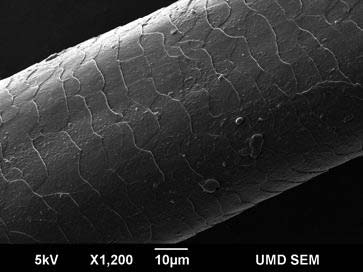
A human hair
Photo done by Scanning Electron Microscopy (SEM)
© 2010 University of Minnesota Duluth
What's the difference between fur, wool and hair? This is a question that has been bugging me for a long time, so I tried to find out the answer. Let me tell you right up front that I didn't find a simple answer. The following is what I have gleamed but please post a comment if you can add any clarity to this question.
Some of this confusion seems to be a matter of word usage, as they are all the same protein (keratin), so technically they are all hair. However, some features that help distinguish the usage of terms: The thickness for example. Hair has lower density with 500 follicles/sq inch although not all are active at the same time, so let's say @100-200 follicles per sq inch should define hair. Sheep wool on the other hand, have up to 60,000 follicles/sq inch (Merino) and if the density is high, like a sea otter which has one of the highest densities at 800,000 per sq inch, the hair is referred to as fur. 
Another characteristic that some use to distinguish between terms is the growth pattern. Fur grows to a certain length then stops, while wool and hair keeps on growing. Although, this all depends on species and genetics, but generally this seems a good separator. Fur tends to have a major shedding time annually. Only the primitive sheep (eg. Soay, Orkney, Hebridean) and the so called 'hair' sheep breeds (eg.Saint Croix, West African, Wiltshire Horn) shed annually. 
Churro sheep wool. SEM
Photo by Dave Lewis and the Ohio 
 Agriculture Research and Development Center in Wooster
Wool tends to be the term for sheep fleece. Some sheep have kemp (thick hairs) in amongst the wool usually in is found in certain breeds of sheep and certain locations (eg. rear end), other sheep and Llamas have double coats with longer guard-type hairs designed to shed water and shorter insulating down fur (eg. Icelandic, Navajo Churro) for warmth.
Alpaca.
Photo by Dave Lewis and the Ohio 
 Agriculture Research and Development Center in Wooster
And then there is the more technical characteristics, like the cellular structure. The hair shaft is made of cuticle cells (keritine) that form scales, overlapping each other and pointing towards the tip. The cells form a protective coating around the cortex (inner area). In the fine merino wool, the cells are one layer thick while human hair can be 10 layers thick. This cellular structure is different for each type of hair (eg. eyelashes, whiskers, hair) from different animals. The scanning electron microscope photos here show some of the different structures. Look at the difference between human hair, churro sheep and angora rabbit in the pictures here. But, it doesn't help much in distinguishing hair from fur from wool.
Alpaca  Light microscope photo
showing the medulation (dark areas).
Photo by Dave Lewis and the Ohio 
 Agriculture Research and Development Center in Wooster
Inside the hair shaft is the cortex. This is the middle of the hair/wool/fur. If the centre of the cortex is hollow we call the core 'medulla' or a medulated hair. The inner core can be a consistently hollow core, or contain sections which are hollow. This medulation can provide insulation, hence hairs with no medulation hold heat less well than medulated hairs. Alpacas and Llamas have medulated hairs while sheep do not, hence Alpaca wool is a better insulator than wool.
Angora. Note the very interesting V-shape cell structure
SEM Photo by Dave Lewis and the Ohio
 Agriculture Research and Development Center in Wooster
So why is this interesting? For a few reasons. The structure of a fibre creates its characteristics for: heat retention; strength, elasticity, felting tendency, light reflection, etc. And also because I want to be able to analyze a fibre and have a way to figure out if it is Mountain Goat or sheep wool or from the Coast Salish wool dog.


Thursday, September 9, 2010

Kent Monkman - The Triumph of Mischief

Detail of Artist and Model
I am writing this away from the prying eyes of Priscilla-the-fleeceless-sheep-that-rules-the-guestroom-and-Lords-over-my-wool-stash. I am not sure she would appreciate the explicit language and pictures of this particular post. She is a bit of a prude. So I will be quick to get it up before she has an inkling of the sexually explicit (and I won't even show you all the details, but use a magnifying glass on the picture to the left) work of this artist and his alter ego.

Monkman's Cher-inspired seance outfit.
I went to a thought-provoking art exhibit by Cree artist Kent Monkman at the Victoria Art Gallery. Monkman has, a wicked sense of humour and of injustice, a subversive wit and his work playing on role reversals, forces us to re-think, re-image, some of our underlying assumptions, stereotypes and visions of reality about the imaginary indian, painted by the noble whiteman.  


They say a picture is worth 1,000 words. In Monkman's paintings a picture is worth 10,0000 words, layers of meanings on top of layers. He is also a performance artist, check out his seance held at the ROM calling on the spirits of explorer-artists Paul Kane, George Caitlin and French romantic painter Delacroix, while dressed in a, reportedly, Cher-inspired drag queen attire, also in the exhibit. Click here to listen to the dance music of MissChief. The seance was in response to one of his paintings being censored from the First People's Gallery at the ROM. As Monday Magazine explains it:
“They gave us the opportunity to go into the museum, look at the collections and then create work as a response. I went straight to the First People’s Gallery and there you have all these paintings by Paul Kane, this voice of authority. It’s like, ‘What are his paintings doing in the First People’s Gallery?’ Yes, the first people were his subjects, but . . . I thought, ‘I’ll do a painting in response to one of his paintings,’” says Monkman. “I wanted to draw attention to that and hang my painting in there with his painting. So the curator of the First People’s Gallery said, ‘No, we can not allow Kent to show in the First People’s Gallery. We can not allow him to challenge the work of Paul Kane.’”
The Academy
which brought on the seance performance and brought about the ROMs re-thinking of just what should be allowed in the First Nation's Gallery.
In this exhibit, the star of this show is Monkman's alter ego Miss Chief Eagle Testicle -- say this fast enough and you have Mischief Egotistical Did I say that Monkman is a master of punning? In the painting titled "The Artist and Model" above, Monkman has painted his alter ego right into the painting. Miss Chief Eagle Testicle (aka Mischief), wearing six-inch heels, a scanty breech, a Chiefs head dress and little else, is the artist painting the naked (penis erect) cowboy. However, Mischief's easel holds a pictograph of her idea of what the white man looks like. See what I mean about layers upon layers of words and meanings.
The picture "The Academy" reminded me of Paul Kane's picture "Clallum Woman Weaving a Blanket". I am not sure that Monkman's Academy was meant to be a reVisionist view of Kane's painting, but there are some similarities, the wool dog in the foreground (see my earlier blog on this painting), the scene in the long house, the viewing of artists creating their works.
In any event, Monkman's imagery will remain with me for a long time.
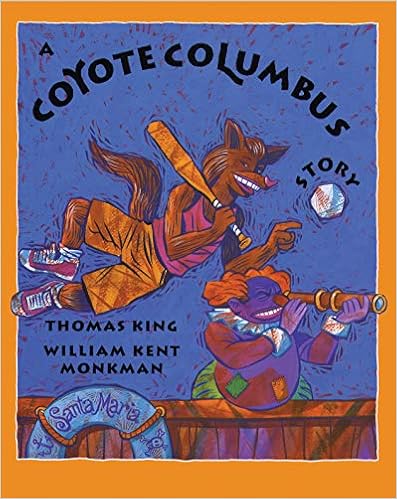
This post seems to be very popular, so I have edited to add a book if you like Kent Monkman's sense of humour as well as his art, then you would probably enjoy this book. It is written by one of my favorite authors, Thomas King who also has a wicked sense of humour and of injustice. Okay, you need to know it is written for children, but hey, read it for your inner child.

"A Woman Weaving a Blanket," Songhees/Saanich (Central Coast Salish)


Tuesday, March 2, 2010

Salish wool dog - update

I just came across a podcast on the Salish wool dog that I thought people would be interested in. It's well done by Sterling at his site The Future Soon. Sterling interviewed Susan Crockford - the dog bone expert mentioned in an earlier post. Here's the podcast:

To see all the Salish wool dog related posts on this site, click this link: Island Weaving Salish dog posts.

 ..side diversion: His site has a great quote
"Science is what you do when you don't know what you are doing."....

Saturday, January 23, 2010

Investigating the use of goat and dog wool in Coast Salish blankets

First, a little summary background on the Coast Salish Wool Dog. There are many Coast Salish blankets in museums around the world. These are said to be made of Mountain Goat wool. Someone, somewhere (I'll have to find a good reference and check this out in more detail) analyzed the fibre from one blanket to figure out what the animal producing the fibre ate (carbon isotope analysis) and found that their diet consisted of 50-70% marine in origin. It is unlikly that Mountain Goat ate that much, if any, fish, so they are ruled out. So if these blankets aren't necessarily all Mtn Goat, what are they made of? 

In addition, there are many Coast Salish territories (Vancouver Island and Puget Sound for example) where Moutain Goat are not found, and from these areas we have Salish Oral history which establishes the existance of specially bred dogs used for their hair as wool in blankets.  

We also have records from some of the early explorers of the area mentionaing these dogs Capt. Vancouver wrote in 1792 while at Bainbridge Island: "...the dogs belonging to this tribe of Indians were numerous, and much resembled those of Pomerania, though in general somewhat larger. They were all shorn as close to the skin as sheep in England..." and the Spaniards while anchored off Nanaimo mention that the dogs "of moderate size, resembling those of the English breed, with very thick coats, and usually white."  

Paul Kane (see the blog posting below) sketched and painted what could be a Salish wool dog. And George Gibbs, surveyor, collector and interpretor/translater in the mid 1800's donated his pet wool dog 'Mutton' to the Smithsonian on its death (see the posting further down).  

So we have oral history, the written word, some possible visuals referring to the dog, and perhaps a preserved dog. And you would think there has to be some dog blankets in existance somewhere but how does one identify dog wool from goat wool? Perhaps some of these goat wool blankets were really dog wool or a combination.

In 2006, 'Mutton' the supposedly Salish wool dog, was found and dusted off and the USA National Museum of Natural History provided Anne Murray, a  Andrew W. Mellon Fellow in Textile Conservation, with the hair of 'Mutton', some of goat, along with some fibres from Coast Salish blankets. The idea was to try and identify what a Salish dog hair fibre looks like and how it can be distinguished from goat fibre. This was done for visual identification using microscopy (scanning and polarized light) and then DNA analysis (mitochondrial). Both the structure of the hairs and the DNA anaylsis support that the blankets did have both Moutain Goat and dog wool. The picture on he left is from a poster overviewing the research done and shows Goat hair on the top and Mutton's dog hair on the bottom.

Sunday, December 13, 2009

Coast Salish Wool Dog - What did it look like?


As promised, I am adding answers, or at least more information, about the Salish wool dog as I find it. So what did it look like? In Paul Kane's painting "A Woman Weaving a Blanket" now at the Royal Ontario Museum, he paints a small white dog, almost poodle like. However, the painting is based on some sketches and his sketches of dogs look different.


Susan Crockford, an expert in archaeological analysis of bones, has done extensive research on the indigenous dogs of the Pacific Northwest Coast, has a sketch on that accompanies her monograph on 'Osteometry of Makah and Coast Salish Dogs' that, knowing her expertise, is probably a good likeness (the dogs on the right).


On a side note, on the Snuneymuwx First Nations web site, the Salish Spindle is discussed, and they mention that Cameron Island was one of the islands used to keep the Salish Wool dog breed separated from other dogs. This makes sense as Cameron Island (which is no longer an island) is very close to where the Solexwel village was, allowing easy access to care and feed for the dogs. There is also on that page, a close up of a diorama that shows two dogs, that may be more accurate than the Paul Kane painting. These dogs also look like the sketch on the right.

Sunday, November 22, 2009

S'abadeb - The Gifts

Cedar, cedar bark, paint, abalone shell and operculum shell
Private Collection


Barbara Brotherton, curator at the Seattle Museum of Art, and the curator of S'abadeb exhibit at the Royal BC Museum gave an interesting talk today. It was a very informative introduction to the exhibit. If you have a chance to see it, do.  

S'abadeb is a Lushootseed term for gifts and conveys the theme of reciprocity of giving and receiving gifts. Gifts both tangible and intangible such as songs and names.
I was lucky enough to have a few minutes chatting with her about Salish spinning, weaving spindle whorls and the wool dogs. She said that George Gibbs, a surveyor and a witness for the signing of the Point Elliot Treaty 1855 in Washington State, was given a wool dog 'Mutton' (he, that dog that is, liked to chase sheep) whose pelt was given to science and currently is in the Smithsonian Museum. She also mentioned a man who claimed he had a dog that was genetically very similar, a Japanese breed.  
My mother mentioned that when she worked with the BC Lands Title Office, where she often had to refer to surveyors records (organized diaries) she thinks she read that an island/s off Gabriola (Flat Top Islands?) was used to keep the dogs separate from non-wool dogs. 
So there are a few tips to follow up on. 
Googling, I came across an article,  'Wolly Dogs' by Elizabeth Flower Anderson Miller who has obviously researched this topic in detail. She suggests that the wool dog is the result of the recessive gene which causes the soft down hair (wool) to grow longer than the guard hair -- the Malamute factor, a lethal flaw for dogs that need to survive in very cold climates where guard hairs are needed to shed water, sleet, snow and ice. However, for the Gulf Islands/Salish Sea area, where snow rarely lasts two weeks of the year, this factor wouldn't be so lethal, rather it would provide much valued thick, long spinnable fibre. I'll do up a blog entry just for questions and answers about the Coast Salish wool dog.

Tuesday, November 17, 2009

Coast Salish Woven Fabrics - More questions than answers


I am curious to know more about traditional Coast Salish woven fabrics, especially those collected pre 1830s. Coast Salish weavings can be incredibly complex. Techniques include twining (double, simple, three-strand), openwork, overlay, tapestry and twill. Some of the patterns were very intricate and made of fibres from dog wool/hair, nettle and mountain goat wool. There is even reference to one that included down. 
Paula Gustafson in her book Salish Weaving writes that she has examined most of the blankets in North American museums and has only seen one of dog hair. So how come so many descriptions and records of wool dogs by some of the early explorers of the area? And where are all these rugs, blankets and other fabrics made from dog hair?

Grant Keddie, from the Royal BC Museum tells me that UVic is getting an electron microscope and there is an expert there is working on analyzing the hairs to try and figure out if they are goat, dog or a mixture. He suggests it is time to re-examine some of these treasures using newer technologies to help solve some of these mysteries. Grant has been interested in the wool dogs for a long time (see Keddie, 1993, Prehistoric Dogs of B.C. Wolves in Sheep Clothing, the Midden, 25 (1)3-5, February. Grant is currently researching the history and use of Coast Salish spindle whorls. He also tells me that Susan Crockford is the local authority on doggie DNA and included archaeoloigal material from RBCM collection and Tatlan Bear dogs in her research. Check out her books and publications. And here is an article on the wool dog.
Some of my questions:
  • What was the Salish wool dog? What did it look like? There is one painting by Paul Kane but is it an accurate likeness? Were wool dogs found up and down the coast of North America? Is there similar breed still in existence? What type of fibre was it? How long, how thick and how much crimp did it have?
  • Many of the blankets were made from mountain goat wool. I don't think mountain goat existed on Vancouver Island, so they must have traded for it. So how common was weaving if the wool came from dogs or mountain goats. Was there enough wool to make this a common activity or a rare activity? If it was common, well, that's a lot of mountain goat and a lot of trade. Was there enough mountain goats? Or was dog wool more common? If weaving wasn't common, then that could explain why there was such value placed on blankets. But then, what was the common fabric?
  • Where did the dye colours red, blue and black come from?  Yellows, tans. browns, oranges, greens come from a variety of possibilities (eg. wolf moss, oregon grape roots, alder bark) but a good black (salty mud?), blue or red (can alder bark really get the traditional reds?) is hard to come by.
Feel free to post any answers.
Speaking of the Royal BC Museum, they have a great exhibit which opens on Nov 20th. S’abadeb – The Gifts: Pacific Coast Salish Art and Artists. 


Edited to add a couple of related books.
Here are a couple of books you might be interested in: 
Working with Wool, a Coast Salish Legacy . Although it looks at the history of the Cowichan Sweaters, it covers the history of the wool too. And Paula Gustafson's Salish Weaving .