Showing posts with label Master Spinners. Show all posts

Thursday, December 27, 2012

It takes a long time to create a masterpiece

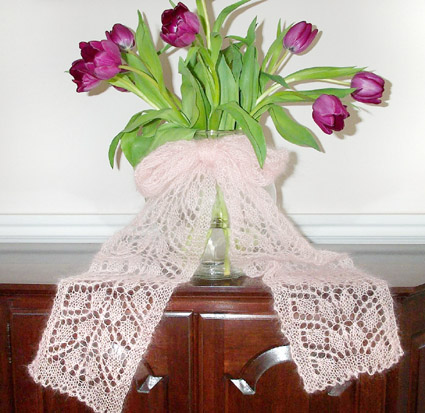
[Photo: Black kid mohair and tussah silk]

As regular readers (my mother, my sister) of my blog know, having spun for three short sweet years in my youth before putting spinning away, I am now endeavoring to roll 25 years of non-spinning, into 6 years of intensive focused and guided catch-up. Hmm, one could read I am attempting to recapture my youth through spinning. Anyway, in other words, I am paying for those lost 25 years by working on a Master Spinning Certificate from Olds College. I am now in year four of the six year program.  
[Photo: Blending on cards and making punis]
Each year you are required to do a major spinning project--this is on top of the regular years worth of spinning homework. The first year required a project that took 25 hrs. This includes selecting the fleece/fibres, cleaning, carding, spinning and, as long as you did it yourself, the weaving or knitting into a finished product. By year three we were up to 50 hours. Year four requires 75hrs! You may think this seems counter-intuitive. As the years go by, one gets better at spinning, so you would think it would take less time. Why by year four, I should be able to dash off an exquisite evening lace shawl in an evening or two of spinning and a weekend of knitting. But it doesn't work that way. Spinning doesn't get any faster, it just gets better. Last year I timed myself and it turns out I can spin and ply a yarn a meter per minute. I timed myself again yesterday and that hasn't changed. It is just my spinning that has. I can spin a decent yarn now. My yarn has integrity even at 1 meter/minute. 
[Photo: Blending on a fur carder]
75 hours sounds like a lot of time but considering I have not finished the spinning of the yarn for this years project and haven't yet begun knitting, the 25+ hours I have already clocked, points out that 75 hours will be a breeze to achieve. Reflect on my lack of knitting prowess, and you understand it will take me at least a hundred hours to knit something given my penchant for mistakes leading to re-knitting a second or third time.
So, what has taken the 25 hours so far?  
Planning 3 hrs; teasing, 4.5 hrs; carding, weighing and blending, 5.5 hours; sampling 2 hours; spinning, 6 hrs; changing my mind, 2 minutes; dying, 3 hours; re-sampling, 30 minutes; spinning up a different batch 5 hrs 15 minutes. Total 29 hours 47 minutes.

This year I decided to make another Holden Shawlette, since 

  1. I have extensive experience with this pattern having ripped it out and re-knit it at least three times, 
  2. having made many, many mistakes in the Holden Shwalette I just finished, I can easily recognize mistakes earlier in the knitting process, and
  3. I now know that I should stick to the pattern and cast on the required number of stitches and not think that I, a mere beginner, can willy nilly adjust lace knitting patterns.

[Photo: Subtle silk colours peek
 out of the black kid mohair]
The spinning goal: to spin a delicate lace weight two ply (two ply highlights the lace pattern) that is sophisticated, subtle, soft, and silky. I selected a black super soft and fine kid mohair and blended it 85/15% mohair and tussah silk. I loved the result and after spinning 408 meters decided the subtle sophistication needed a little jazzing up so I experimented and threw silk into various dyepots to find just the right colour to add the needed jazz. I ended up sprinkle dying the silk using a variety of harmonious colours. Next I experimented more with the spinning technique and blended the silk and mohair on hand cards, then rolled it into punis to spin in a semi-woolen technique. But that didn't produce much difference in the yarn (i was looking for more loft) from the semi-worsted method and it took a lot longer, so back to the fur drum carder and I blended the fibres into large batts and stripped off sections to spin in a semi-worsted style.
Stay tuned for adventures in the knitting.

Wednesday, December 19, 2012

Flax to linen

[Photo: Tow and line linen]
I have been spinning linen...or flax? I guess I have been spinning flax and at some magical Rumplestilkskinian moment the flax turns into linen. And like the captive maiden's spinning, mine too turned into gold!
[Picture from Franz Eugen Köhle'sr,
Köhler's Medizinal-Pflanzen 1897
]
I didn't think I would enjoy spinning flax but I do. There is something about the neat, tidy, golden threads that tugs at your ancestral memories. It is comforting. Well...maybe not comforting in the same way that spinning wool is comforting, but linen satisfies. I don't know why, I am just reporting how it effects me. And satisfying is the way I feel after spinning flax into gold linen.


"The life of a flax plant is 100 days of thought..."

[Photo:Flax stem cross-section
Photo: Ryan R. McKenzie
]
So here are a few things I learned along the way. Flax is a plant and the fibre comes from the inner bark or bast of the stem, so the fibres are, at the longest, the length of the plant, maybe around 2 feet. To make a long story short, during the processing of separating the fibre from the plant, you can end up with a pile of short fibres (the tow) and a pile of long fibres (the line). Okay, okay linen spinners, I know, I know, I am over simplifying, but we have to keep up the interest of non-spinners. If you want to know more about the very interesting processing of flax, check out this beautiful video 'Be Linen' video. I digress...

Each of these types of fibres can be spun. The tow will produce a fuzzy yarn and the line...oh, the line flax, sigh, will produce a beautiful golden yarn. There are a variety of spinning techniques from using the classical distaff to accordion folding of the fibres. Each method is designed o allow only a few threads to draft out into the yarn yet also allowing those threads to grab their following threads to keep a continuous line of yarn forming as you spin. Then, you can spin wet or dry. Wet spun will smooth the yarn and give it a higher gloss, and dry spun allows more frizz to show. Then we can get more technical and spin with water or spit. Yes, spit, as in drool, saliva. I haven't seen proof of this, but rumour has it that saliva works on the flax enzymes, making the fibres glue together, while water helps control the flax and makes it softer, easier to spin and creates a smoother yarn, but doesn't create the glue.  

But here's the thing...you can blend linen with wool, or cotton, or silk or....who would have thought? Endless possibilities!

EDITED Dec 31, to add 2 more pictures.

Tuesday, July 10, 2012

Lost .... and found at sea

Photo, design and
decoration by Laura Landry.


Readers of the blog will wonder where on earth I have been. Well, I have been up to my eyeballs spinning trying desperately to finish all my assignments for the year. D-day (driving-day) to get to Olds Alberta for year 4 class arrived and I still hadn't finished all my homework for year 3 of the Master Spinner program. The last homework assignment (spin embroidery yarns and embroider a 3 x 3" sampler) wasn't done. The thread had been spun for months but that doggone embroidery had still to be done. I embroidered for 1,000 kilometers, followed by two evenings before it got done. So on day three, tada, of level 4 class, I handed it in. Whew!
I returned home with a suitcase full of fibre and an armload of assignment instructions for the coming year. I have been back six days and still haven't had time to unpack everything. It was the Nanaimo Dragon Boat Festival all weekend and I was on the water all weekend. 
While I was away, our team, the Vancouver Island Ancient Mariners, posted a new bra on the Newcastle Channel 'bra pole'. I don't know what the original purpose of the pile was, but some years ago, it was decided that it should be decorated by bras, so dragon boaters, while out practicing add their mark. Note the miniature graduation cap on the left cup. Nice touch!
This years festival theme was the 60's, so we went as ourselves...hippies. We paired up again this year with Seventh Wave, a fantastic team from Vancouver who went Mondrian and British. Check them out.

Thursday, June 14, 2012

Lost in TPI land

Followers of this blog may wonder where I have been for the past month. Well, I have been in TPI land, or TPI hell which is more accurate. TPI=Twist per Inch. 
The assignment: spin 10 yards of yarn at 1 twist per inch. Sounds easy right. HA! Sounds simple. Deceptively simple. Deviously straight forward. Wrong! Anything but! At 1 TPI (count the bumps along the edge of a yarn in a one inch length and divide by the number of singles making the yarn - more on this frustrating formula later) most yarns tend to fall apart. It requires a very grabby fibre but after a few frustrating failed attempts I dug out my shetland roving bought at THE Jamieson's in the Orkney Islands. Sigh, such beautiful special fibre and it seemed a waste to just throw a lot of it away in attempting this sample. But after a while I was able to do it. On to the next assignment: spin ten yards at 2 TPI. A few attempts to achieve precisely (well, I have the marker doesn't look too closely) 2TPI and on the the next assignment. Spin 4TPI. Then 8TPI, 12 and 15 TPI.  
Somewhere between 8 and 12 TPI I realized I did not know how to count TPI. Seems silly, given my formula above but when your attempts to achieve these assignments, especially the higher TPIs do not work, then you start to question everything. Ergo: how do you count bumps? Just the bumps on one side of the yarn, or both sides of the yarn. One side it turns out is correct. But then somewhere between 12 and 15 TPI I forgot to divide by the number of plies. It seemed impossible to spin at 30 bumps per inch but 15 bumps more doable. At this pint I was producing unusable yarn with so much twist one couldn't use it for anything but a rats nest. Hence I was questioning all the instructions. They didn't work.
Then there are the questionable formulas to figure out how much twist to put into each single (this involves length of draft or fibre between you and the wheel, your wheel ratio (how many twists each time the wheel goes around) and how many times you let the wheel turn per draft. I double checked the formulas, yes, they were correct. Then how come my yarn turns into a hopelessly tangled twisted knot? This went on for, I am ashamed to admit this, but 3 months of cursing and spinning junk! So that is where I have been. TPI hell.
The solution turned out to be all in the fibre. Selecting the right fibres for the job was critical. Spinning to the crimp (think curls, waves, in a fibre) worked for the medium TPIs but at the extreme end, one needed to think and select carefully. Silk, for example is much easier to spin at 15 TPI than wool. Take my word for it.

Sunday, February 5, 2012

A project for Cuba

Havana Cuba January brought a quick trip to Cuba.   This was a pure R & R trip.  With only seven days, the idea was to sit on a beach.  Oh, sure, I admit to having a weak, ill-thought out plan to find the bee hummingbird (the smallest hummingbird in the world) but once I saw the beach, that quest was put away for another trip. We did manage to drag ourselves to Havana for a short day where I found a group of women learning to knit, but then it was back to the beach and a couple of novels.
[Photo: A group of women
knitting in downtown Havana]
With hours of flights and just as many getting to the airport and sitting waiting for the plane, I decided I needed a project and since I am behind in my spinning homework, I thought it wise to pick a project that would get me a little further ahead in my homework.  For my major project this year, I have to spin a yarn and then knit or weave it into something.  From start (preparing the fleece) to finish (a usable product), the project should take 50 hours.  I have so far spent 25 hours sampling (1 hour), cleaning and teasing fleece (8hrs), blending and carding (4hrs)  fibres (40% mohair, 40% alpaca and 20% silk), preparing skeins for dying (2 hrs), mordanting (1 hr) and dying the skeins (4 hrs), plus 1 hour on calculations.  This was to be for a woven scarf, but at the end of all this work, my weft which was to be a soft pink turned into a rather gaudy, vibrant, purple.  I had enough purple for a scarf in itself.  I was still happy with the yarn a soft 2 ply suitable for weaving or knitting lace.  So if the planned weft was too harsh to go with the soft, subtle colours of the warp, then knitting would be a good alternative, except I can't knit anything more complicated than knit and purl and even then my knitting is questionable.  This I decided was the perfect time to learn how to knit and knit lace at that.
[Photo: My first lace knit project]
So I 'googled' beginner knit lace and found this pattern from Knitty.com.    Perfect.  The description says it is good for beginners.  that's all the time I had to read before printing the chart, downloading a 'How to Knit ' app for the I-phone (complete with how-to videos, and packaging my purple yarn off I went to Cuba.
[Photo: From Knitty.com]
I want to point out a couple of items of interest in my photo of my WIP (Work in progress).  First, note the turquoise thingy, it is a Knit Kit, advertised as 'never lose your knit knacks ever again'.  I bought it from Knotty by Nature on my way to the airport, and am so glad I did.  It has a row counter, crochet hooks for those darned stitches you drop by accident, stitch markers, tape measure and even scissors apparently approved for air travel (personally, I think it is because they fold so cleverly that the x-ray machine can't see the sharp pointy bits).  If you are a knitter, never leave home without it.  The second thing I want to point out, is if you look closely about an inch below my needle is a blue yarn sewn into the knitting.  It's called a lifeline and it is. My knitting has improved but I tore apart the first 3 inches probably a dozen times, and even now, with a seasoned 164 rows behind me, I knit three rows ahead and often rip five rows back.  The lifeline allows me to rip back to the start of my ten row repeat pattern.  Every ten rows I use the handy dandy darning needle which came withe the Knit Kit and darn through the row.  Then when I have to rip out a few rows to get back on track, I can rip away right back to the lifeline without having any lost/dropped stitches.
On getting back home, I went back to Knitty.com to re-read everything and that's when I realized this wasn't actually a 'beginner's' beginner's project, it was for advanced beginners who are ready to tackle something more difficult. As the instructions say 'So, once you've knit this scarf you can knit just about any lace pattern.'  
And it is true ....I think.

Wednesday, January 18, 2012

What's on the wheel

I love my new wheel (Ashford Joy WITH a Woolee Winder -- I am sure there will be a post on that later). I especially appreciated it's smoothness when I got stuck in TwistsPerInch (TPI - for those non-technical and hence, sane readers). The problem was too much information, not enough understanding and conflicting formulas in my mind. The homework assignment was to spin ten yards of a plied yarn at 15 TPI. Sounds easy but it ain't! To make a long story short, in my frustration at not succeeding in this seemingly simple assignment, I said 'bugger it, I just want to spin and picked up a beautiful roving from Hummingbird Fibre Arts, consisting of Romney wool, mohair and silk and spun my frustration away'.
But now I am stuck on a totally different problem. How best to ply this wonderful roving (on the bobbin on the right)? In order to keep the varigated colours vibrant, I don't want to ply it with itself as the colours will mute each other. I could navajo ply it but that would result in a beautiful 3 ply and I am aiming for a 2ply. So I had my mother pick up some pink tone soft and silky merino/silk roving from the Loom at Whippletree (on the bobbin and wound into a ball on the left). It too is beautiful but do I want to mix them together (the pink/blue sample in the foreground) ? Decisions, decisions. I think I will spin up a few bobbins before I decide. Perhaps by then I will have figured out how to spin a 15TPI plies yarn.

Monday, December 5, 2011

Shetland wool - It's a first!

Shetland wool has now received protected status. Just as Champagne, or Feta and Camembert Cheese is protected, ie. you can't sell products using those names, unless of course, you have produced them in those geographic areas that hold the right to use those names. So Shetland wool is the first non-food item to be protected in the EU.
More good news to the Shetland Islanders who are finally making more money from shearing their sheep than it costs to shear them.  

see earlier blog about the Shetlands.

[Photo: Not perfect but close enough
 to 1 TPI]
Speaking of Shetland wool, I have an assignment to spin a 2-ply yarn at 1 Twist Per Inch. Sounds easy. It wasn't! I finally achieved something close to that using a lovely Shetland combed top that I bought from Jamieson and Smith Woolbrokers in Lerwick in the Shetland Islands. This is a beautiful wool, a pleasure to spin and knowing the fineness one can spin this, it was, in a way, a shame to spin it so thick. But, I was pleased with how it came out. Now I just wished I had purchased more. But you can order it online here.

Sunday, June 12, 2011

NOT Art yarn

[Photo: Jacey Boggs, wearing a
beehive coil-to-be]
I spent the weekend on Quadra island with an inspiring instructor -- Jacey Boggs, and 11 other students. We were there to learn 'hardcore and softcore' spinning, which is another name for textured yarns and is NOT another name for Art Yarn. Jacey rues the day when she coined the term 'Art Yarn'. The term was originally meant for yarn with integrity, yarn with structure, yarn that is usable and not just something to put on the mantelpiece. But that meaning has been lost and the term is now being used for yarn that is pretty to look at but not much good for making anything. For two days we learned how to create yarns with structure, with integrity. We learned how to make textured yarns, interesting, beautiful to look at, fun and usable yarns.  
[Photo: Stephanie's beehive coils]
We used some wonderful fibres. A beautiful hand painted merino top (sponsored by SpringtreeRoad) which we used for thick and thin yarn and for coils and an incredible batt from Sayra of Atomic Blue. You have not seen batts until you've seen these! Check out their products with the links embedded.
[Photo: AtomicBlue batt and yarn samples.
Much more vivid in real life]
Jacey has a book coming out this fall (December?) on making textured yarns --Spin Art: Mastering the Craft of Spinning Textured Yarn. I think this will be one of 'those' books that will have a tremendous impact on spinning. It will take spinning to a whole new level. I suspect it will generate a lot of buzz and a lot of new spinners. Keep an eye on her blog for this and for her new DVD (her current DVD covers this workshop). Heck, check her blog anyway. She's one of those special people that will inspire you and leave you envious of all her energy. 
[Photo: Michelle getting a kick out
of  being loaded into a tiny boat
and kidnapped]
I came away from the workshop just as energized (v. 1. to make energetic, vigorous or active. 2. another word for overspun kinky single yarn ) as the yarns we made. I also came home with Michelle, my soon to be Master Spinner Level 3 instructor! I have her tucked away in the guest cabin known as the Hilton. Yes. My own private spinning instructor. I may not let her off the island.

Thursday, December 23, 2010

Homework - am I there yet? NO

Homework, as far as the eye can see...
I have been busy lately...and stuck in the colour wheel assignment ...but I have lost track of where I am and how far I have to go. Let me sum it up...a looooong way! As panic is starting to set in, I thought I better get on top of where I was so I stacked everything up on table, organized the assignments into three categories: Finished (i use that term loosely), halfway there and still to do. Then I counted: 9 items done, 9 half way done and 22 still to go!
And this is just the actual spinning, then there are the written assignments, the 10 book reviews and the spinning major 25hour project.
Then I figured out how many days to go -- 109 days. Well, that's not so bad. It's still possible. Maybe I will have time for Christmas baking.
On the left: done; Centre: half done; Right: kits waiting for action.

Saturday, December 18, 2010

Lost in a colour wheel

You might be wondering where I am with my Master Spinners homework. Well, I am stuck in a viscous circle - the twelve colour wheel circle. It is not hard, nor boring, nor tedious, it is just taking time. The assignment: Create a colour wheel. It requires weighing each colour, then blending colours equally by weight, then spinning them and finally create a colour wheel. Here's how it works: take three primary colour merino roving - yellow, blue and red. Blend each of the primary colours with another primary to get three more colors, eg. red + blue = violet. Keep in mind that the new blend has to be homogeneous - blended very carefully, striped colours will be rejected. So I card very careful using the drum carder, running the new blend through the drum 3 - 4 times. Then take the new colour (or, figure out the correct portions of the primary colours that produced the new colour and add to it to et the new colour - you can see where this is getting confusing) and blend with the primary on each side eg. violet + blue = violet/blue, violet+red= ...hey wait a minute, what does that make and where is it? Excuse me while I card more wool....

Tuesday, October 19, 2010

Homework

Getting my homework organized to begin.
Priscilla-the-fleece-less-sheep-that-rule-the-guest-bedroom-wool-stash, has stamped her hooves and has threatened me, "Get this #@$% stuff out of here. For Gawds sake do something with it. Or else" and 3 bags of fibre samples meant for homework were thrown into the hallway.
Heavy hoofed but she was right, it was time to start my homework after all, it has been 4.5 months since my Master Spinners Level 2 course and that meant I only have 5.5 months left to finish it. Yikes!
I have been procrastinating but for a very good reason. Integrity. After being told in class that my yarn lacked integirty (see the earlier post) , I have been spinning up a storm trying to achieve integrity and I think I am there and now ready to tackle the bags of fibre homework.
So I spent this afternoon laying out all the fibre and putting together homework 'kits'. Each kit is in a ziplock bag and holds the instructions and fibres. So kit #33 for example contains some black Llama and some Frieson x Suffolk sheep fleece and instructions: spin a 10 yard skein of a blend suitable for a knitted vest. It may be 2 or more plies (I'll do a 3ply). Give an explanation of why it is suitable and knit a 3" x3" swatch to demonstrate its suitability.
I reckon each kit will take an average of 3 hours to complete. There are 40 kits and then there is the written work (say 10 hours...maybe, maybe more), plus I have to do a final project that takes at least 25 hours: I have to design, wash, prepare, dye, blend, spin and knit or weave something like a scarf. It is almost enough to cause me to give up before I really begin.  Homework is due April 15th (I'm not sure but let's assume it is around there), and that is 6 months away. That sound like a lot, but in terms of days it is 180 days.
So here is the maths: 40kits x 3hrs = 180hrs + 25hrs major project time = 205 hrs + 10 hours written homework = 215 hrs.
Assuming that in that 6 months I will be in a workshop for 4 days, away on holidays for 9, and out of commission for one reason or another for, say, oh 5 days, that means that I would only have 180-18 = 162 days available, which is about 1.25 hours a day will get me to the finish line. Put another way that means finish one kit every two days. Sounds possible except I work full time and sleep at least 8 hrs/day. I usually have 2 hours a day available. This doesn't leave a lot of room. I better get crackin'.

Thursday, July 15, 2010

Yarn with no integrity!

I did not really want to admit this. It has taken me more than a week to gather up my courage to confess publicly how well, err, how much I still have to learn after attending year two of the Olds Master Spinners course. The course is starting to get technical about our spinning. Things like how many twists per inch (TPI) in your yarn, the number of wraps per inch (WPI), the number of treadles you treadle while drafting a foot of yarn. Stuff like that. Technical things that are expected to be achieved by accomplished spinners, which we were expected to be. We would be given assignments and told to spin it, mark it with all the vital yarn info (TPI, WPI, twist angle) and hand it in for assessment. The instructor would then review our attempts in a class discussion. She held up mine as...
"a perfect example of a yarn WITH NO INTEGRITY! " . I gulped.
I cringed. I grinned like a sheepishly like an idiot. She went on. "It is subject to pilling! And, abrasion! To pulling apart. Wearing out. " Oh myyy gaaawd. I wanted to hide under a fleece. I thought about the baskets and baskets of my hand spun yarn without integrity, waiting for me at home (remember the 774 grams of Gotland I just spun....down the tube.) . Waiting to pill and fall apart. And Priscilla-the-fleeceless-sheep-that-rules-my-stash whom I could hear even from this distance saying "I could have told you THAT."
So much for the learning theory that goes something like 'sleep on it and your brain will incorporate the concepts and muscle movements while you sleep.' Yeah right. If you consider that I started spinning 30 years ago and stopped for 28 years before starting again a year ago, you could say I have been sleeping on it for at least 28 years! To no avail.I spent the two day drive home in the car using a drop spindle, learning how to spin yarn with integrity. Maybe in another 28 years.

Friday, July 2, 2010

Up to my #@$% in Fleece

Last night I found myself bidding on fleece at a silent auction at Olds Alberta.  Blue Faced Leicester, Leicester X Corriedale, Mohair, Llama, Alpaca, and a few more. These fleeces had been judged on Sunday and I was lucky enough to be right there to watch them as they pulled, poked, smelled, twanged, measured the fibres and gave  each fleece a grade.  And I listened to everything they said.  Well, almost.  But in any event, they were kind enough to let me peer over their shoulders and listen to their fibre wisdom.  I watched the wool and the mohair judging and peeked once in a while with the cashmere judging but I couldn't fit in the Llama and Alpaca.


And then I placed my silent auction bids, writing down on a card in front of the bagged fleece, the amount I bid.  On some fleece I was the first bidder, on others I was the second bidder. Future bidders would write their bid below mine. I imagined racing around the hall many times, upping my bid while other bidders did the same.  The auction was open for a day and a half but i would be in class for most of that time.  With so much fleece at stake, it made more sense for me to start placing my bids.  It would be too risky to be coy and wait until the last minute.


I did my first charge around the hall.  One bid for the incredible Leiscter x Corriedale, another bid for the Blue Faced Leiscter, and another for a fine Romney, but, I was careful and stuck to what I had learned.  Yup, quality, show winning fleece!  But what about the other types of stash, the luxury fibres.  Well, I should place a bid on a mohair, maybe two bids to hedge my luck and what about Llama.  What beautiful greys and blacks, better place a bid or two or three, hoping for at least one.  And before I knew it I had bids all over the place until I suddenly stopped and thought "What if no one else bids higher than my bid?  What if everyone else is in class with no time to bid?  What if I had to pay for all my bids? What have I already bid on?"  And then I realized I had been bidding hither and thither and had no idea just how many bids I had placed.  So much for only bidding on those fleeces that had won ribbons.


I walked the aisles again this time looking for my name on the cards and writing down in my notebook what I had bid on so when i did my next mad dash around the hall I could just hit those fleeces I had already bid on and ignore the rest.  I went down the first aisle and realized I hadn't put a bid on the gray BFL x Merino.  I better do it while I was there.  And the Frieson x Suffolk, why it is only at $20, it's worth more than that, why that is less than $2.5/lb, I better put a bid on that.  And so it went.  I was dizzy with bids.  I kept bidding rather than writing down what I had already bid on.  I gave up.  


I am worried, all those bags in the picture will not fit into the car.


... It is a day later.  I find myself the owner of three, 3! three, black lama fleeces.  And 7lbs! of Frieson x Suffolk.  In a sad way, I am relieved that I was not successful on my bids for the Blue Faced Leicester, the Romney, the Icelandic, the Kid Mohair, the Adult mohair, the... well you get the picture.  The trunk is full now anyway.


Priscilla-the fleeceless-sheep-who-rules-my-stash will be happy with this haul.  M-the hubby will not be.

Wednesday, June 30, 2010

Road Trip

Guess where?   We're in the 'Bad lands' .  It doesn't seem so bad to me. Maybe I am seeing things with rosy glasses It could be the wet spring: the rivers are high, the fields are green, the lilac is in bloom, the sky is blue, the air temperature is just right. There doesn't seem to be much 'bad' around. The dinosaurs are dead but their bones remain. That's good.  The landscape down in the river valley is dramatic, that's not so bad.  And the Tyrell Museum is a kids dream. I could spend hours describing things, but there is a reason for this road trip: Masters Spinners Level Two residency at Olds College, which just happens to be during Olds Fibre Week! So I will skip the road trip highlights and blog about the course...and fibre. But later. I have an exam to study for first.