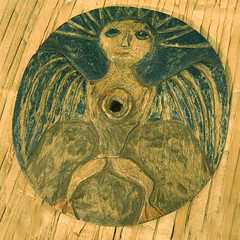
Showing posts with label whorl. Show all posts

Saturday, September 29, 2012

Textiles Day 3

First impressions of Washington: People are very helpful. I noticed this earlier having received emails from staff at the Smithsonian but, well, it can be easy to convey kindness, thoughtfulness, friendliness and helpfulness from emails. More importantly, I found it to be true in person. Doormen, security guards, hotel clerks, curators. They are all friendly, relaxed and helpful. Even in the National Museum of the American Indian cafeteria where there was a lineup of people desperate for coffee and food, a potentially stressful situation for the workers, but no, they took it all in stride. The were relaxed and just kept producing and serving all the while with a calm smile on their faces. This was also true of the corner Starbucks downtown, where the lineup went out the door. People seemed happy.
Second impression. Washington DC is a professional, urban city. Lots happening, lots of culture, lots of government buildings, lots of suits and ties, lots of slim working women and a ton of tourists who just may learn something from the locals.
[Photo: National Museum of the
American Indian]
I rented a bike from one of those bike stations scattered about the city. This is the way to see Washington! Although, I also saw groups of people both young and old, scooting around on Segways, those two wheeled stand-up vertical scooters.
I biked over to the National Museum of the American Indian which is a stunning building. Designed by the same architect that designed the Canadian Museum of Civilization. See my blog post about that building here.  
Built into the wall of the atriums' 4 story high lobby are prisms aligned perfectly to cast their rainbows into the bulls-eye centre of the floor at summer and winter solstice.
[Photo:Salish spindle whorls]
While there, a drummer sang and beat his drum in the centre of the atrium. It was a powerful performance with the beat of the drum going right through your being.

And it was wonderful to see, right in the entrance of the atrium, four Salish spindle whorls from home, three old ones, and a new modern glass one 'Sacred Circle' by Susan Point. One of the wooden whorls is from Snuneymuxw (top right)1840-1900, the others are from Cowichan one whorl with salmon and raven carved onto it and the other with a double-headed serpent design both from 1800-1860.

Sunday, September 5, 2010

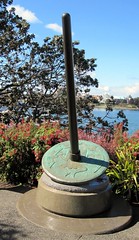
Victoria Spindles - Signs of the Lekwungen

Spindle whorl marking
 llqemasan (Camosun)
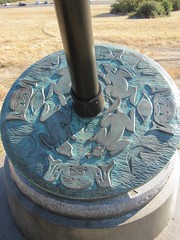
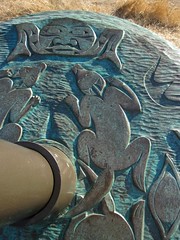
A few years ago the City of Victoria worked with the Esquimalt and Songhees First Nations, to create and place seven larger-than-life spindles and whorls marking seven important Lekwungen locations around the city.  This picture was taken at what was a Hudson's Bay Fort, Fort Camosun, later known as Fort Victoria.  It marks the two worlds meeting.
“ I remember my grandma using a spindle whorl. She didn’t speak much English, and I didn’t speak much Coast Salish, but I understood that the spindle whorl is the foundation of any family – it can weave a tapestry of information.”  Butch Dick, Songhees artist and designer of the spindle whorls
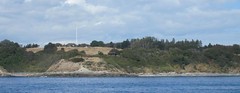
The second spindle is at the highest point in Beacon Hill Park, 'Meqen' (which means warmed by the sun) overlooking the Salish Sea, and on the far shore, the Olympic Peninsula.  On the hillside, 'Coqwialls' a game similar to field hockey was played and lower down a village once stood until about 300 years ago.  Camus, a wildflower and bulb that provided a sweet carbohydrate is found in abundance in this area.  Just off shore, fish were caught using reef-net fishing techniques.
Beacon Hill Park, just below the spindle whorl

Sunday, May 16, 2010

The Glenbow Museum, Calgary

A quick trip to Calgary for a conference gave us the opportunity to check out the Glenbow Museum. This museum is well worth the visit. One of the highlights is their exhibit on the Niitsitapi (The Blackfoot) - Our way of life. It covers how their culture, connection with the land, connection with plants, buffalo and other animals.  


I was particularly impressed with the pictographs recording major events such as the year smallpox struck and killed so many. Here's an example of Raw Eater's (a warrior hunter) recording on a buffalo hide, of his hunting and other feats.  
We were lucky to see a special exhibit which closed a day or two later, the Sacred Robes exhibited five hide shirts that had been collected over 150 years ago. These shirts (with one exception) depicted sacred stories and histories of the Blackfoot nation.


On another floor, is an exhibit of First Nations artifacts from the north, south, east and west of the Niitsitapi. I spotted the Coast Salish spindle whorl and had to take a picture of it.