Showing posts with label salish. Show all posts

Saturday, September 28, 2013

A Coast Salish Blanket hidden in Alaska


While wandering the exhibits, my husband heard what he thought was an announcement about a Salish blanket and rushed over to me. I hadn't heard it so we headed to the front desk to inquire. It turned out a staff member had radioed another asking if they had seen the Salish blanket and that is what he heard. It seemed my earlier email had started a hunt for a lost Salish blanket. Apparently neither museum could find it! I said I was the one who had stared the panic. They were most helpful and apologetic for misplacing the blanket and they kindly showed me all the pictures they had on file. When we finished, somewhat disappointed but appeased by the photos and conversations, we followed the suggestion of the woman at the front desk and headed across the parking lot, into the State building up to the 8th floor where I logged into the internet. Surprisingly (and most fortuitously) an email from the curator 'Come back, we found the blanket!' So back we went and had a wonderful time looking closely at Judge Wickersham's blanket.

In a summer post, I had promised to tell you about a special find in Alaska. It is a relatively unknown Coast Salish blanket once owned by Judge Wickersham. He lived in Washington State, purchased the blanket somewhere there (more on this next year as I follow an interesting lead) and took it with him when he moved to Alaska.  And there it remains, in the Wickersham House Museum...although that isn't where I saw it and that is part of the story of fortuitous luck.
I found out about the blanket from another Salish blanket researcher, Elaine Humphrey, an expert in microscopes. Elain has been investigating the fibre contents of Salish blankets using Scanning Electron Microscopy (SEM) - a fancy microscope for extreme close-ups (see my SEM post). She had been to see the blanket and collect some fibres from it. Most interestingly, there is a small patch of black fibres which when she put under the SEM, turned out to be human hair. There is just a little of this fibre in the blanket. Think about it. Was it the weaver's hair? The spinner's hair? The original owner's hair? Was the blanket dedicated to someone? I would love to know the hidden story behind it.
[Mark Kaarremaa Photo:
Close up detail
showing black hair fibre
next to the blue triangle]

I was already booked on a cruise to Alaska but somehow had the mistaken impression that the Wickersham House Museum was in Fairbanks and that would involve a plane trip from the Alaskan Coast to Fairbanks, not something I could fit in for this trip. I happened to be talking with Elaine the week before the trip when I mentioned this and she exclaimed " Fairbanks! No. The blanket is in Juneau." I practically ran home and phoned one of the state curators who was kind enough to start arranging with the Wickersham House a visit for me.
The day before leaving on the cruise I received an email. It seems the blanket had apparently been moved from the State museum back to the Wickersham House but we hadn't quite connected with the curator there to view it. I hoped that by the time the ship got to Juneau, we had arranged for a viewing.
Internet connectivity is on cruise ships is terrible! It should be inexpensive and a decent speed. It isn't. If you can send emails for free from 30,000 feet above the earth, then surely you can send from sea level??? To make a long story short, we arrived in Juneau and no word from the curator. I assumed that I just hadn't given them enough time. None-the-less, we decided to visit both Museums.

[Photo: Judge Wickersham's
blanket hanging on the wall
.]
Cruise ships do not advertise things like local museums. It is a shame. The State Museum in Alaska (see earlier post) is well worth a visit! We entered, paid a minimal fee and the woman at the desk gave us some good hints on where to go next ( cross the road, through the parking lot, into the State Building, take the elevator,get off at the 8th floor for a good view, stop by the library where there is internet service, go out the far door from the 8th floor out to the upper street and then head for Wickersham Museum). We hoped we could remember all that but in the meantime looked around the incredible exhibits. 


Judge Wickersham was bigger than life. Statesman, author, Judge, pioneer, keeper of the peace in the gold rush. He was on the first team of white men to climb Mt McKinley. And wrote 43 diaries in which he recorded life. It is heart wrenching to read his entry about loosing his son. His diaries from 1900 until his death 1939 can be found here.
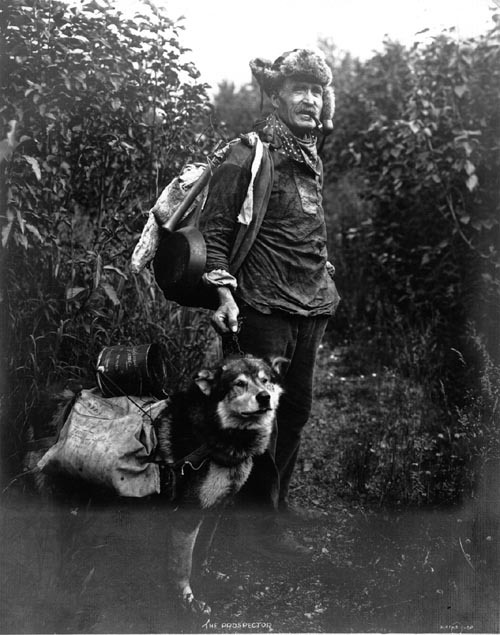
[Photo: Judge Wickersham]  
The picture at the top is the blanket as of 2013. Note the hole. There is another hole a bit smaller in the lower right just out of the photo. The Judge apparently liked to sit on the blanket on his chair, so the holes line up when folded and also lined up with his tush. Note the picture at the bottom of the blanket on the wall taken before 1940. It is hard to see if this size photo but click the link to see the full image and you will notice it has been folded. The stripe in the middle is really the right edge of the blanket but has been folded in to, I suspect, hide the two holes. Interestingly the blanket also hides the full story of the black hair.

Saturday, December 17, 2011

Coast Salish Blankets - a Mass Spec Update

[Photo: Salish robe, 1838-1842, Wilkes Expedition,
from the Smithsonian collection, #E2124-0]
Big news in the Coast Salish weaving world. Researchers from York University analyzed nine Salish textiles (blankets, trump lines) at the Smithsonian to try to determine what fibres were used. They used a mass spectometry technique (a way to identify molecules by their mass) to solve the question 'is there dog hair in the blankets?'  
This question has been nagging at those interested in these blankets for a long time. It is a weird question. We have Coast Salish oral history telling us this is so. We have written logs/diaries by early explorers like Capt. Vancouver, also saying dog wool was used. We have artists who wrote and even painted what was probably a wool dog (Paul Kane). But we still want 'proof'. Interesting that 'proof' has a hierarchy, which I suspect goes something like this: artwork somewhere at the bottom, then oral history, written diaries and logs, official documents, and then there is scientific 'proof' at the top. And even scientific proof has hierarchies depending on what is trying to be proven.  'Proof' has layers. One layer of proof builds upon another until you have the full story of the 'ultimate truth'. Different layers take a weak proof like a myth and builds onto it. Each layer builds more certainty in the proof. Add more layers, and the myth solidifies until you have an irrefutable fact. More proof makes it more solid, like a textile.
[Photo: Salish robe, from the
 Smithsonian collection,E1891-A]
With the wool dog fibre, the proof story goes something like this:

  1. Oral history tells of the wool dog and it's wool being used in blankets and robes..
  2. Early explorers (Capt. Vancouver) records the use of dog wool in textiles.
  3. Early artists (Paul Kane) painted a dog that could be a wool dog and wrote of wool dogs, but artists license means this in not 'proof that the dog existed or looked like what Paul Kane sketched or painted'.
  4. Eye-balling the fibre in Salish blankets show at least two different fibres, but many animals, like the Mtn Goat have an outer coat and a downy coat. So even if there are two different types of fibre, it doesn't prove that they belong to two different animals.
  5. Scanning electron microscope (SEM) was used to look at fibre magnified to see differences, but it wasn't reliable for fibres that are very old as fibres can wear. A new fibre will easily show the scales on the outside but old fibres rub and wear down those scales, so it isn't conclusive when looking at the outside of the fibre. And even if the old fibre was in really good shape, we need a wool dog fibre as the baseline to compare with. How can we identify a wool dog fibre if we don't know what one looked like in the first place? No wool dog, no proof.
  6. Carbon isotope analysis - This research showed that some fibres came from an animal that ate a diet of marine food. Wool dogs were fed salmon, but carbon isotope analysis can only prove that the animal did eat marine food but can not 'prove' that the marine food was salmon, nor that animal eating the marine food is a dog. See this blog for more info.
  7. 1997, Osteometry (analyzing the bones) showed that there were two species of dog in the Pacific Northwest coast. This helped prove that there was intentional breeding to keep the two species apart. Why would they want to? There must have been a benefit in keeping the breeds pure, but what that reason was we can only surmise it was for the wool of one of the species. A forensic artist used the bones to sketch out what the dog could look like and there is a resemblance to the Paul Kane sketch and painting. But that doesn't prove it.
  8. Scanning electron microscope (SEM) analysis - split hairs. Someone came up with the idea that if SEM wasn't reliable for old worn fibres, then what about the inside of the fibre? Split the hair and then magnify it. Lo and behold, it turns out that the inner hair tells a lot and is very useful for telling fibres apart. But, you still need to know what a wool dog fibre looks like in the first place.
  9. Then, in 2006 in a dusty drawer somewhere in the Smithsonian, someone finds Mutton, a wool dog' or at least what is left of Mutton -- his pelt, which had been donated to the museum sometime. We now have a wool dog fibre! We have the baseline to compare old robes and blankets with.
  10. Back to SEM and now we can compare a Mtn Goat fibre with a wool dog fibre. Check out the picture in this blog posting.
  11. DNA analysis has been used to identify DNA in a Salish Blanket as being from a dog. Other blankets showed DNA from a Mtn. Goat. So DNA can be used to identify fibres in textiles. We are still waiting to hear more about this ongoing research at the Smithsonian.
  12. Mass spectometry - identifies dog hair in the textiles and this is the research that was recently announced.
Yes, there now seems to be 'scientific proof that dog hair was used in some Salish blankets. Or put another way, there is now 'scientific proof' that what people said, saw and wrote about did indeed exist. And, we now have a host of techniques that can be used to help identify dog hair being used in blankets.
Click here to see all my posts on the wool dog and Salish blankets.
Here are a couple of books you might be interested in: 
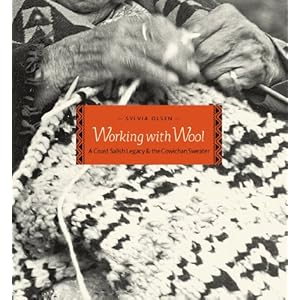
Working with Wool, a Coast Salish Legacy . Although it looks at the history of the Cowichan Sweaters, it covers the history of the wool too.
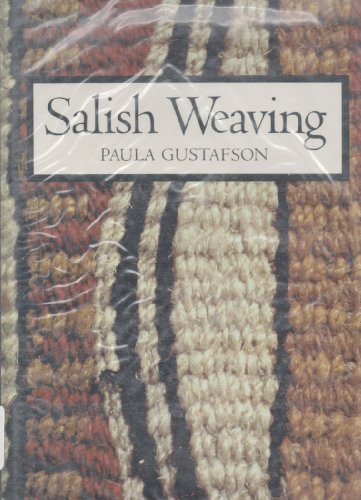
And Paula Gustafson's Salish Weaving . Although it is out-of-print, it is currently the best book available on the history of Coast Salish weaving. I am awaiting eagerly Leslie Tupper's book which I believe should be close to being available.


Sunday, September 5, 2010

Victoria Spindles - Signs of the Lekwungen

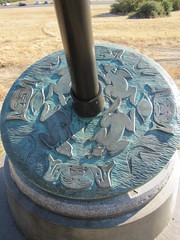
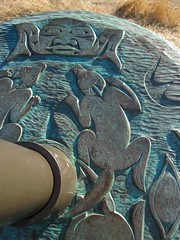
Spindle whorl marking
 llqemasan (Camosun)
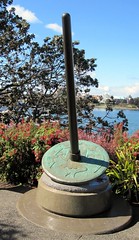
A few years ago the City of Victoria worked with the Esquimalt and Songhees First Nations, to create and place seven larger-than-life spindles and whorls marking seven important Lekwungen locations around the city.  This picture was taken at what was a Hudson's Bay Fort, Fort Camosun, later known as Fort Victoria.  It marks the two worlds meeting.
“ I remember my grandma using a spindle whorl. She didn’t speak much English, and I didn’t speak much Coast Salish, but I understood that the spindle whorl is the foundation of any family – it can weave a tapestry of information.”  Butch Dick, Songhees artist and designer of the spindle whorls
The second spindle is at the highest point in Beacon Hill Park, 'Meqen' (which means warmed by the sun) overlooking the Salish Sea, and on the far shore, the Olympic Peninsula.  On the hillside, 'Coqwialls' a game similar to field hockey was played and lower down a village once stood until about 300 years ago.  Camus, a wildflower and bulb that provided a sweet carbohydrate is found in abundance in this area.  Just off shore, fish were caught using reef-net fishing techniques.
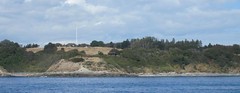
Beacon Hill Park, just below the spindle whorl

Tuesday, August 10, 2010

The Secret of Cowichan Wool - the sheep

Washing fleece in Iceland
Thirty odd years ago when I took a spinning course from Judith McKenzie McCuin I remember her telling us about the Cowichan sweater yarn and what had made it so special - a yarn that was light, bulky, yet very warm. So the traditional Cowichan sweater did not weigh very much. She mentioned that the fleece was from sheep resulting from a variety of mixed breeds that provided wool that was high in lanolin (good for repelling water), and had a good crimp which was needed for the fibres to press against each other creating lots of air pockets which provides the insulation. Ever since I have wondered what breed of sheep created those characteristics (see an earlier blog in which I was still wondering). What did the early settlers and the Coast Salish women use for those amazing, warm, lightweight, sweaters?
Today I was reading an older issue of Spin-Off and came across an article written by Judith in which she provides the answer (MacKenzie McCuin, J. (2008). On Washing Fleece. Spin-Off Magazine, 32(3), 64-68.)! A cross breed of Churro sheep which had been left on islands in the Georgia Strait (now known as the Salish Sea) to provide meat for ship wreaked sailors or future sailors in search of nourishment, and down breeds such as Dorset and Hampshire brought over later by settlers. So, after 30-odd years I stumbled across the answer.
I now have an even higher respect for Churro sheep (see and earlier post about Navajo churro). The Gulf Islands can dry out in the summer and there isn't much in the way of green grass, hence the Churro would have done just fine, as they did in the American mid-west where the Navajo raised them.
Judith's article goes on to explain how the fleeces were cleaned: they were either spread over fences or hedges, allowing the rain to clean them or placed in a fast-running creek. The water cleans out the dirt and suint (a type of sheep sweat but it is a natural detergent) but leaves in the lanolin which provides the rain-proofing for the yarn which is ideal for this wet climate.
I wonder if there are any cross-breed sheep of this type left?
Edited to suggest a great book on the history of Cowichan Wool and sweaters:
Working with Wool, a Coast Salish Legacy . Although it looks at the history of the Cowichan Sweaters, it covers the history of the wool too.

.

Sunday, May 16, 2010

The Glenbow Museum, Calgary

A quick trip to Calgary for a conference gave us the opportunity to check out the Glenbow Museum. This museum is well worth the visit. One of the highlights is their exhibit on the Niitsitapi (The Blackfoot) - Our way of life. It covers how their culture, connection with the land, connection with plants, buffalo and other animals.  


I was particularly impressed with the pictographs recording major events such as the year smallpox struck and killed so many. Here's an example of Raw Eater's (a warrior hunter) recording on a buffalo hide, of his hunting and other feats.  
We were lucky to see a special exhibit which closed a day or two later, the Sacred Robes exhibited five hide shirts that had been collected over 150 years ago. These shirts (with one exception) depicted sacred stories and histories of the Blackfoot nation.


On another floor, is an exhibit of First Nations artifacts from the north, south, east and west of the Niitsitapi. I spotted the Coast Salish spindle whorl and had to take a picture of it.

Saturday, April 10, 2010

Cowichan Knitting - Fleece questions

I wonder what type of sheep fleece were traditionally used for Cowichan Sweaters. Judith MacKenzie McCuin, spinner extroidinaire and author of a couple of recent spinning books, told me years ago that she thought the sheep were a mixed breed of down sheep, that had adapted to the Cowichan Valley area. They would produce fibres that had a lot of crimp which would produce yarn that is light, holds insulating air, hence very warm and bulky without the weight. They also had a lot of lanolin which was kept in during the spinning to make a very rain resistant garment. I remember her telling me that a friend, Marg Meikle (who took the photo on the left), also known as Canada's Answer Lady (from the CBC) had researched Cowichan knitting and had written a small book on the subject.   So I contacted Marg. Marg has had Parkinson's for over a dozen years now, but that hasn't infected her famous 'need-to-know' drive. Marg told me that she had uploaded her book to wikipedia, and sure enough, there it is (all 78 meg worth). But in Marg Meikle's book that accompanied a Cowichan Sweater exhibit that traveled across Canada in 1986, it was mentioned that traditional sweaters were very heavy and that helped prevent commercial knitting machines from replicating the Cowichan knitting. I wonder if they really were heavy or if it was the lanolin that prevented machines from duplicating the yarn? Anyone know?
If you'd like to download Marg's book, click on this link and ignore all the ads as you don't have to buy anything to download it, you just need patience for it to start downloading. After a 30 sec pause in which they hope you will have second thought and buy something, it will start downloading but beware, it is 76meg, so if you have a slow connection it will take a while.

Tuesday, March 2, 2010

Salish wool dog - update

I just came across a podcast on the Salish wool dog that I thought people would be interested in. It's well done by Sterling at his site The Future Soon. Sterling interviewed Susan Crockford - the dog bone expert mentioned in an earlier post. Here's the podcast:

To see all the Salish wool dog related posts on this site, click this link: Island Weaving Salish dog posts.

 ..side diversion: His site has a great quote
"Science is what you do when you don't know what you are doing."....

Saturday, January 23, 2010

Investigating the use of goat and dog wool in Coast Salish blankets

First, a little summary background on the Coast Salish Wool Dog. There are many Coast Salish blankets in museums around the world. These are said to be made of Mountain Goat wool. Someone, somewhere (I'll have to find a good reference and check this out in more detail) analyzed the fibre from one blanket to figure out what the animal producing the fibre ate (carbon isotope analysis) and found that their diet consisted of 50-70% marine in origin. It is unlikly that Mountain Goat ate that much, if any, fish, so they are ruled out. So if these blankets aren't necessarily all Mtn Goat, what are they made of? 

In addition, there are many Coast Salish territories (Vancouver Island and Puget Sound for example) where Moutain Goat are not found, and from these areas we have Salish Oral history which establishes the existance of specially bred dogs used for their hair as wool in blankets.  

We also have records from some of the early explorers of the area mentionaing these dogs Capt. Vancouver wrote in 1792 while at Bainbridge Island: "...the dogs belonging to this tribe of Indians were numerous, and much resembled those of Pomerania, though in general somewhat larger. They were all shorn as close to the skin as sheep in England..." and the Spaniards while anchored off Nanaimo mention that the dogs "of moderate size, resembling those of the English breed, with very thick coats, and usually white."  

Paul Kane (see the blog posting below) sketched and painted what could be a Salish wool dog. And George Gibbs, surveyor, collector and interpretor/translater in the mid 1800's donated his pet wool dog 'Mutton' to the Smithsonian on its death (see the posting further down).  

So we have oral history, the written word, some possible visuals referring to the dog, and perhaps a preserved dog. And you would think there has to be some dog blankets in existance somewhere but how does one identify dog wool from goat wool? Perhaps some of these goat wool blankets were really dog wool or a combination.

In 2006, 'Mutton' the supposedly Salish wool dog, was found and dusted off and the USA National Museum of Natural History provided Anne Murray, a  Andrew W. Mellon Fellow in Textile Conservation, with the hair of 'Mutton', some of goat, along with some fibres from Coast Salish blankets. The idea was to try and identify what a Salish dog hair fibre looks like and how it can be distinguished from goat fibre. This was done for visual identification using microscopy (scanning and polarized light) and then DNA analysis (mitochondrial). Both the structure of the hairs and the DNA anaylsis support that the blankets did have both Moutain Goat and dog wool. The picture on he left is from a poster overviewing the research done and shows Goat hair on the top and Mutton's dog hair on the bottom.

Monday, December 28, 2009

Salish Spindle Whorl


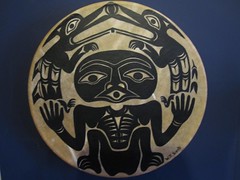
It has been a busy Christmas season, hence a lack of blogging. However, we purchased a special item this year, a drum made by Richard Aiscaican who makes superb drums. His attention to detail marks him as a master drum maker. Check out the photo of the sides and back of the drum where you can see the patterns created from the even application and pressure between the sinew and the drum skin.

The image on the drum is painted by Joel Good a Snuneymuxw member. It is based on a Salish spindle whorl, a crouching naked figure (needing warm fabic?) with two sea serpents wolves facing each other at the top (edited to reflect Joel's correction -thanks Joel). This is from the Snuneymuxw creation story. Apparently sea serpents are more common in the Nanaimo area than elsewhere. The mouth of the human would be where the spindle shaft would be inserted.
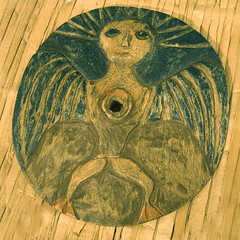
Below is a picture of a similar whorl design from the Canadian Museum of Nature. The Snuneymuxw First Nations Band Council uses the spindle design as a logo as can be seen in the photo of the Band Office window on the web page describing spindles.


Sunday, December 13, 2009

Coast Salish Wool Dog - What did it look like?


As promised, I am adding answers, or at least more information, about the Salish wool dog as I find it. So what did it look like? In Paul Kane's painting "A Woman Weaving a Blanket" now at the Royal Ontario Museum, he paints a small white dog, almost poodle like. However, the painting is based on some sketches and his sketches of dogs look different.


Susan Crockford, an expert in archaeological analysis of bones, has done extensive research on the indigenous dogs of the Pacific Northwest Coast, has a sketch on that accompanies her monograph on 'Osteometry of Makah and Coast Salish Dogs' that, knowing her expertise, is probably a good likeness (the dogs on the right).


On a side note, on the Snuneymuwx First Nations web site, the Salish Spindle is discussed, and they mention that Cameron Island was one of the islands used to keep the Salish Wool dog breed separated from other dogs. This makes sense as Cameron Island (which is no longer an island) is very close to where the Solexwel village was, allowing easy access to care and feed for the dogs. There is also on that page, a close up of a diorama that shows two dogs, that may be more accurate than the Paul Kane painting. These dogs also look like the sketch on the right.

Sunday, November 22, 2009

S'abadeb - The Gifts

Cedar, cedar bark, paint, abalone shell and operculum shell
Private Collection


Barbara Brotherton, curator at the Seattle Museum of Art, and the curator of S'abadeb exhibit at the Royal BC Museum gave an interesting talk today. It was a very informative introduction to the exhibit. If you have a chance to see it, do.  

S'abadeb is a Lushootseed term for gifts and conveys the theme of reciprocity of giving and receiving gifts. Gifts both tangible and intangible such as songs and names.
I was lucky enough to have a few minutes chatting with her about Salish spinning, weaving spindle whorls and the wool dogs. She said that George Gibbs, a surveyor and a witness for the signing of the Point Elliot Treaty 1855 in Washington State, was given a wool dog 'Mutton' (he, that dog that is, liked to chase sheep) whose pelt was given to science and currently is in the Smithsonian Museum. She also mentioned a man who claimed he had a dog that was genetically very similar, a Japanese breed.  
My mother mentioned that when she worked with the BC Lands Title Office, where she often had to refer to surveyors records (organized diaries) she thinks she read that an island/s off Gabriola (Flat Top Islands?) was used to keep the dogs separate from non-wool dogs. 
So there are a few tips to follow up on. 
Googling, I came across an article,  'Wolly Dogs' by Elizabeth Flower Anderson Miller who has obviously researched this topic in detail. She suggests that the wool dog is the result of the recessive gene which causes the soft down hair (wool) to grow longer than the guard hair -- the Malamute factor, a lethal flaw for dogs that need to survive in very cold climates where guard hairs are needed to shed water, sleet, snow and ice. However, for the Gulf Islands/Salish Sea area, where snow rarely lasts two weeks of the year, this factor wouldn't be so lethal, rather it would provide much valued thick, long spinnable fibre. I'll do up a blog entry just for questions and answers about the Coast Salish wool dog.

Tuesday, November 17, 2009

Coast Salish Woven Fabrics - More questions than answers


I am curious to know more about traditional Coast Salish woven fabrics, especially those collected pre 1830s. Coast Salish weavings can be incredibly complex. Techniques include twining (double, simple, three-strand), openwork, overlay, tapestry and twill. Some of the patterns were very intricate and made of fibres from dog wool/hair, nettle and mountain goat wool. There is even reference to one that included down. 
Paula Gustafson in her book Salish Weaving writes that she has examined most of the blankets in North American museums and has only seen one of dog hair. So how come so many descriptions and records of wool dogs by some of the early explorers of the area? And where are all these rugs, blankets and other fabrics made from dog hair?

Grant Keddie, from the Royal BC Museum tells me that UVic is getting an electron microscope and there is an expert there is working on analyzing the hairs to try and figure out if they are goat, dog or a mixture. He suggests it is time to re-examine some of these treasures using newer technologies to help solve some of these mysteries. Grant has been interested in the wool dogs for a long time (see Keddie, 1993, Prehistoric Dogs of B.C. Wolves in Sheep Clothing, the Midden, 25 (1)3-5, February. Grant is currently researching the history and use of Coast Salish spindle whorls. He also tells me that Susan Crockford is the local authority on doggie DNA and included archaeoloigal material from RBCM collection and Tatlan Bear dogs in her research. Check out her books and publications. And here is an article on the wool dog.
Some of my questions:
  • What was the Salish wool dog? What did it look like? There is one painting by Paul Kane but is it an accurate likeness? Were wool dogs found up and down the coast of North America? Is there similar breed still in existence? What type of fibre was it? How long, how thick and how much crimp did it have?
  • Many of the blankets were made from mountain goat wool. I don't think mountain goat existed on Vancouver Island, so they must have traded for it. So how common was weaving if the wool came from dogs or mountain goats. Was there enough wool to make this a common activity or a rare activity? If it was common, well, that's a lot of mountain goat and a lot of trade. Was there enough mountain goats? Or was dog wool more common? If weaving wasn't common, then that could explain why there was such value placed on blankets. But then, what was the common fabric?
  • Where did the dye colours red, blue and black come from?  Yellows, tans. browns, oranges, greens come from a variety of possibilities (eg. wolf moss, oregon grape roots, alder bark) but a good black (salty mud?), blue or red (can alder bark really get the traditional reds?) is hard to come by.
Feel free to post any answers.
Speaking of the Royal BC Museum, they have a great exhibit which opens on Nov 20th. S’abadeb – The Gifts: Pacific Coast Salish Art and Artists. 


Edited to add a couple of related books.
Here are a couple of books you might be interested in: 
Working with Wool, a Coast Salish Legacy . Although it looks at the history of the Cowichan Sweaters, it covers the history of the wool too. And Paula Gustafson's Salish Weaving .

Saturday, April 25, 2009


Nettles and Alpaca


Last weekend started with a conference on First Nations Traditional Foods.  Talks on Friday, then feasting and playing the bones game Friday night.  Spotted at the display was a dried plant with long stems, dried and looking like hay.  This was dried nettle. Wound onto a short stick, was line, somewhat like fishing line.    Saturday was a traditional food fair at the Snuneymuxw Long House.  Abe, who was studying First Nations root gardens, was cooking up a meal.  Potatoes done in a cedar box of water, heated by placing red hot stomes into the water.  The fire was removed from the pit to make way for ferns and salal which was quickly laid in the pit, vegetables added, more ferns and salal, a bucket of water, burlap and covered with a foot of dirt.  Abe removed the cooked potatoes with a handmade ladle, made of wood, twine made of young willow bark and nettle. 
Someone else had told me earlier that the Saanich First Nations used willow for their reef fish nets.  Judith MacKenzie McCuin (who taught me how to spin years ago) writes about indigenous use of nettles in the introduction of her new book The Intentional Spinner .

lipobibliophobia - the fear of being somewhere without a book.

Sunday, a bike trip along the old Cowichan Valley railway.


But first a stop at
Pacific Sun Alpacas (by lucky co-incidence, just about on the trail) to buy some fleece. A very friendly and enthusistic owner who, of course, is a spinner, shows me how to sort a fleece.  I buy a sample--the neck fleece of Lumina, a cream-coloured alpaca-- to take home and try.  I'll bring it back and she will help me card it into rovings with her new carding machine.  Lipofibrephobia.  I buy a couple of bags of rovings to keep me spinning.