Sunday, December 12, 2010

Fur, hair and wool - what's it all about?

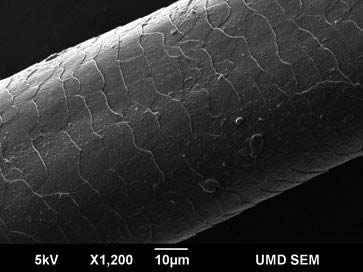
A human hair
Photo done by Scanning Electron Microscopy (SEM)
© 2010 University of Minnesota Duluth
What's the difference between fur, wool and hair? This is a question that has been bugging me for a long time, so I tried to find out the answer. Let me tell you right up front that I didn't find a simple answer. The following is what I have gleamed but please post a comment if you can add any clarity to this question.
Some of this confusion seems to be a matter of word usage, as they are all the same protein (keratin), so technically they are all hair. However, some features that help distinguish the usage of terms: The thickness for example. Hair has lower density with 500 follicles/sq inch although not all are active at the same time, so let's say @100-200 follicles per sq inch should define hair. Sheep wool on the other hand, have up to 60,000 follicles/sq inch (Merino) and if the density is high, like a sea otter which has one of the highest densities at 800,000 per sq inch, the hair is referred to as fur. 
Another characteristic that some use to distinguish between terms is the growth pattern. Fur grows to a certain length then stops, while wool and hair keeps on growing. Although, this all depends on species and genetics, but generally this seems a good separator. Fur tends to have a major shedding time annually. Only the primitive sheep (eg. Soay, Orkney, Hebridean) and the so called 'hair' sheep breeds (eg.Saint Croix, West African, Wiltshire Horn) shed annually. 
Churro sheep wool. SEM
Photo by Dave Lewis and the Ohio 
 Agriculture Research and Development Center in Wooster
Wool tends to be the term for sheep fleece. Some sheep have kemp (thick hairs) in amongst the wool usually in is found in certain breeds of sheep and certain locations (eg. rear end), other sheep and Llamas have double coats with longer guard-type hairs designed to shed water and shorter insulating down fur (eg. Icelandic, Navajo Churro) for warmth.
Alpaca.
Photo by Dave Lewis and the Ohio 
 Agriculture Research and Development Center in Wooster
And then there is the more technical characteristics, like the cellular structure. The hair shaft is made of cuticle cells (keritine) that form scales, overlapping each other and pointing towards the tip. The cells form a protective coating around the cortex (inner area). In the fine merino wool, the cells are one layer thick while human hair can be 10 layers thick. This cellular structure is different for each type of hair (eg. eyelashes, whiskers, hair) from different animals. The scanning electron microscope photos here show some of the different structures. Look at the difference between human hair, churro sheep and angora rabbit in the pictures here. But, it doesn't help much in distinguishing hair from fur from wool.
Alpaca  Light microscope photo
showing the medulation (dark areas).
Photo by Dave Lewis and the Ohio 
 Agriculture Research and Development Center in Wooster
Inside the hair shaft is the cortex. This is the middle of the hair/wool/fur. If the centre of the cortex is hollow we call the core 'medulla' or a medulated hair. The inner core can be a consistently hollow core, or contain sections which are hollow. This medulation can provide insulation, hence hairs with no medulation hold heat less well than medulated hairs. Alpacas and Llamas have medulated hairs while sheep do not, hence Alpaca wool is a better insulator than wool.
Angora. Note the very interesting V-shape cell structure
SEM Photo by Dave Lewis and the Ohio
 Agriculture Research and Development Center in Wooster
So why is this interesting? For a few reasons. The structure of a fibre creates its characteristics for: heat retention; strength, elasticity, felting tendency, light reflection, etc. And also because I want to be able to analyze a fibre and have a way to figure out if it is Mountain Goat or sheep wool or from the Coast Salish wool dog.


Monday, November 29, 2010

Minus 36 degrees

View from down town Saskatoon to the Bessborough Hotel
We interrupt this blog with a quick visit to Saskatoon where the temperature was -36 degrees. So cold I didn't even feel it. And into this cold I went on a horse-drawn sleigh ride in the moonlight. It was wonderful. Quick but worth every second. Highlights:

  • the sleigh ride
  • meeting a whip cracking champion (see upcoming post)
  • watching two friends volunteer to hold a paper ribbon between their teeth while the whip cracker split the ribbon in half, time and time again until the ribbon was a mere 3 inches between them.
  • a successful food quest in search of a real Ukrainian dinner. We found it at ' A Touch of Ukraine' where we had three types of perogies (okay, two types and what we think was a deep fried third), cabbage rolls and borscht.
  • and, another first in public spinning, this time in Saskatoon, Calgary and Vancouver airports....Rats. I should have taken a picture.
  • oh and a pitch fork BBQ - 4 steaks to each tine and the pitchfork was dunked into a vat of boiling oil. Steaks done in two minutes. Pictures to come.

Saturday, November 13, 2010

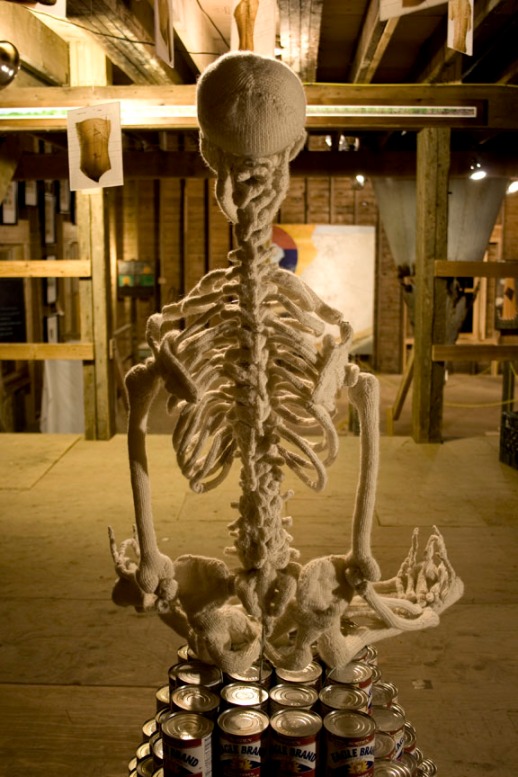
Transcending the Material

Photo by Ben Cuevas from his
installation 'Transcending the material'.
Every once in a while I get deeply inspired by some unique knitting project. Inspired enough to make me want to pick up some knitting needles and knit madly, furiously, intensely. Knit until I feel I really and truly understand knitting, that I know it so well that I can create my own patterns. So well, that I can eclipse and exceed the pattern, not needing any pattern, not even my own. I would rise above and go beyond being just a good knitter. I would triumph over tricky stitches. I will see something in my mind's eye and using my own stitches, my own designs, make knitting do anything I want. I could control it and knit anything I want. I would transcend the material.
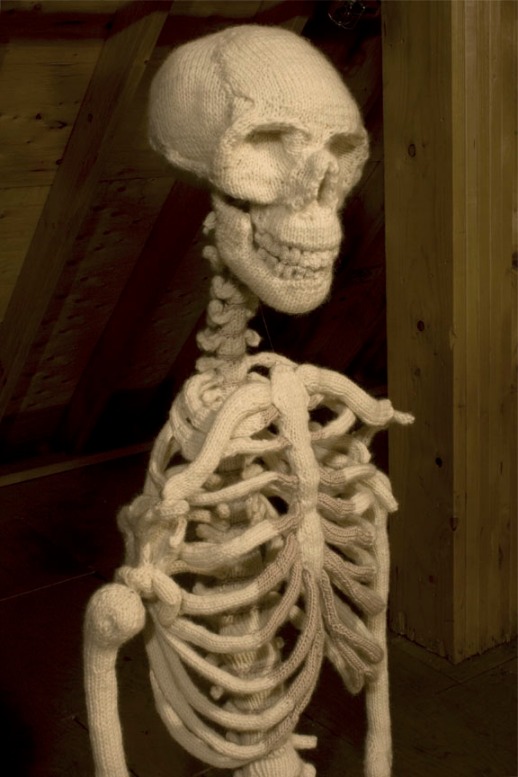
Photo by Ben Cuevas of a
closer view of his skeleton.
Photo by Ben Cuevas showing the knitted
detail of the hand.
Recently, I came across someone who had reached that pinnacle of knitting, Ben Cuevas, philosopher, artist, knitter.
Check out his installation available on his blog. And, here is an interview with him.
Ben Cuevas interview, 2010 Wassaic Artist Resident from The Wassaic Project on Vimeo.

Monday, November 8, 2010

November Light

Dawn at work
,
View from my office
I interrupt the homework blitz to show you a few pictures of things that caught my attention in the exquisite light that has been making things glow around here lately. I suppose it is due to the lateness of the year, the low angle of the sun, the lack of cloud cover, rain, drizzle, fog, low lying cloud and general greyness that is usually common here in November.
Colour on campus
Light at the end of the day.

Sunday, October 31, 2010

One left foot

One twisted ankle
Did I mention I signed up for a 'Learn to Run' class? Yup, they teach this. And there is a lot to learn (where to land on your foot for example) and a lot of homework (practise)! It's a great way to become a runner. I know this because I have taken the course before and had worked up to running 13 minutes, then a 2 minute walk and repeat the sequence. It got me through a 5k run in a respectable time. But that was a few years ago a a few pounds lighter.
Well, this time I failed. Flunked out. We got to the midterm and I had worked up to be running a full three continuous minutes, then a two minute walk and was feeling pretty good about this progress when I found a pothole, at the 30 minute mark, in the side walk and down I went. I limped back to work (this being a lunch time activity) where the first aid people bandaged me up, gave me a cold pack and strict instructions to keep it elevated as much as possible for the first 48hours. Apparently early care means an early heal (no pun intended).
I do not mind being housebound or couch bound, but here is the problem. My right foot is the sprained one and my spinning wheel is a single right-foot treadle. What's the good of being house and couch-bound with 36 more spinning homework kits awaiting and with only one left foot?
Alpaca and black walnut dyed wool, drum carded
 (on the left), combed (in the middle) and being
 dizzed into fine tops which were rolled until
ready to spin (on the right)
I returned to the guest bedroom aka the wool stash and without awaking Priscila the spirit, the-fleece-less-sheep-that-rules-the-guest-bedroom-wool-stash, dug into the homework bag that held the kits still to be blended, combed, carded and dizzed and spent today seated in the sunroom aka the production studio and carded, belnded, combed and dizzed a few more kits, so at least I felt I was making some progress. Back on the couch, I resorted back to the spindle and am now working on a blend of silk and mohair. Very deluxe. But I am getting ahead of the next post.
Count down: 150 days to go (using revised deadline date of March 31)

Thursday, October 28, 2010

Adams River Sockeye Boondoggle and Kit #19

Sockeye salmon heading up the Adams River
Dead fish lining the shores of
Shuswap Lake
The river ran red. Really. This is the BIG BIG BIG year for the Adams River Sockeye salmon run. For some reason, every four years, there is a bumper year for sockeye returning fish--after their first year, spent in fresh water, the little tykes head down river and spend the next three years in the ocean before returning to their birth place. So a big year is every 4th year and this was a 4th year. Despite predictions from some quarters of a crash, this year was the biggest year since 1913, 34.5 MILLION FISH!. Compare that to last years 1 million fish. This was BIG BIG. Once in a lifetime. So we had to go see it.  Click here to see my slide show.
Spinning Kit# in the van
We've been to the last 4th year run and 8 years before, and they were impressive, so I didn't know how this could be even more impressive. It wasn't that we saw more fish swimming up river- maybe we did but I never counted--but what we saw was more dead fish. After they spawn they die. It's their destiny. So while the line of fish kept going up river, those that spawned and died, floated back down the river and lined the shores of Shuswap Lake. The mouth of the river was thick with dead fish. Now think about this. 34.5 million fish all spawning then dying and littering the shore. That adds up to a lot of dead fish with decaying, rotting flesh. The smell was, well, it smelt. Bearable but the smell did linger with us for hours. .....hmmm, I better have someone with a sensitive nose, check the aroma of kit # 19 - fine grade fleece wool spun and prepared worsted-style, spun in the van on the way there and carried in my pack while viewing and sidestepping dead fish.
Count: 4 down 36 to go

Saturday, October 23, 2010

Day 3 and 4, Kit #38

Spinning in the car - not while I drove.
Okay, Kit #38 is supposed to be at the finish line, or at in sight of it but I panicked. I was worried about all the travelling I had coming up in the next week and thinking I would be a week behind with only 1, maybe 2 kits completed.
I was off to Victoria to meet with a curator at the BC Museum to look at historical photos of Coast Salish spinning (but that's another story) and then to go to the Victoria Hand Weavers and Spinners Guild meeting, which meant that I wouldn't have time to spin. Eureka, I would take my spindle and the Kit (#38) that required a 10 yard sample of a 2 ply yarn done with a drop spindle. I could spindle at the Guild meeting, and while the other half drove, I could spindle in the car. And this gives me a good idea. For all those trips, I will select some other kits that would be suitable to use the spindle. One big headache solved.
Which brings me back to Kit #38, a blend of beige llama blended with a Frieson x Suffolk cross both of which had a similar length staple and I had dyed the wool with Black Walnuts to get that ho-hum beige. The mix is a very nice, soft camel coloured yarn.
Time: 1.5 hours driving, 1 hour in a meeting, 1 hour plying in the car, in the dark using a flashlight! = 3.5 hours (including coffee stops)
Count: 3 down, 37 to go.