Tuesday, September 20, 2011

A West Coast Basket

[Photo: The collective work of the
whole class]
I seem to have been bitten by the basket bug. I am supposed to be focusing on spinning, but rationalized learning basketry to find out more about west coast fibres that were used in spinning and weaving. Things like spinning cedar bark. SO, this basket making is just a waypoint on my route. A pleasant foray, I must admit.

This workshop, taught once again by Joan Carrigan (see also the post below on the Cat's Head Basket) was a study in Pacific Northwest materials and techniques. We used red cedar for the framework, yellow cedar for a bit of twining, willow and wild cherry bark, and bear grass and scrirpus americanus -- sedges have edges.
Techniques included plain over-and-under weaving, also twill, plaiting, twining, reverse twining and using twining to give different effects. To top it off, (pun intended) we did a tricky rim using a technique Joan had learned from the Lummi First Nation in Puget Sound.
[Photo: A living willow fence.  Photo from the Vegetable Gardener]
Joan told us a funny story about a famous aging rock star, a living woven willow fence and a basketry mentor she has in France. While studying with him, he took her to the estate of this rock start where he was employed to create and care for a living woven willow fence for this famous rock star. After ten years, the basketry/fence mentor suggested to the aging rock star that the fence be taken down and started from scratch again as the fence was getting too overgrown and showing its age. At which the aging rock star, in a dead-pan, not-to-be-argued-with voice replied ' Aren't we all'. And that was the end of that conversation.

Tuesday, September 6, 2011

A Cat's Head Basket

A lack of blog posts doesn't mean a lack of things to blog about, just a lack of time. Take this post for example, you'll see I have been busy with something a little different. 
I branched out (pardon the pun) into a slightly different branch of the fibre world and took a course in basketry from Joan Carrigan on Saltspring Island.
Joan is a very accomplished basketry artist. Check out her web site to see her gallery of works and see her workshop list.
What fun we had! A group of six of us met and worked side-by-side for the day on these Cat's Head baskets. Cat's head is from the shape of the basket when held upside down. It looks like a cat's head with each corner like ears on a round head.
   
We used red cedar for the main structure and used willow bark to weave a twill pattern onto and through the cedar. Yellow cedar was used to twine the edges together with a couple of rows of waxed linen thread to accent the rim. And just look at the finished baskets. So inspired, I have signed up for another one in a week.

Wednesday, August 17, 2011

From there to here

[Photo: There. Glasgow train station]
[Photo: Here. Ruxton Island, Salish Sea]
Paddling in the Shetlands
From there to here in 24 hours. Travelling is fun but when you live in such a beautiful spot, it's wonderful to return home.


Highlights:

  • canoeing in the Shetland Islands
  • seeing the tall ships in the Orkney's and Shetlands
  • seeing puffins
  • watching my mother eat haggis vol au vent
  • watching my 82 year old father riding a skateboard on his stomach coming out of a 5,000 year old iron age burial chamber
  • learning to spin on a tahkli in the car while being driven all over Scotland
  • Salisbury Cathedral
  • examining a Coast Salish blanket in the Perth Museum
  • seeing a feather cape in the Pitt River Museum in Oxford
  • coming home to summer in the Gulf Islands

Thursday, August 11, 2011

Paisley - The Shawl, the museum

[Photo from Spurlock Museum]
If one is staying at Paisley, which is where the Glasgow International Airport is located, and if one is passionate about beautiful fabrics, then you must visit the Paisley Museum to find out about the famous Paisley shawls.
Paisley is, or was, a mill town.  According to our taxi driver, in its heyday, the two main mills (Coates-as in J. & P. Coats and Anchor threads) employeed 40,000 people.  Now they employ a mostly volunteer force to keep the Thread  Mill museum open 2 days a week. One of the mills has been turned mostly into flats.  The Coats mills still operates but on a much reduced basis.
I had hoped to visit the Paisley Thread Museum, the Anchor Mill and the Sma' Shot Cottage, a weaving history cottage, but these were only open on Wednesdays and Saturdays and this was a Tuesday.  Sigh.  But the Town Museum had some beautiful shawls and weaving equipment on display.
The weavers in Paisley based their designs on fabrics that came from Asia.  So they did not design the original Paisley shawls. Other mills were doing the same thing and producing copies of Eastern patterns, but in Paisley, they produced the shawls cheaper and quicker than other mills, hence they became more popular and more famous.  I thought it interesting that the museum pointed out that Paisley weavers were notoriously argumentative and British politicians always has a wary eye out for revolutionary actions emanating from Paisley.
The museum weaving expert was on holiday but we were allowed in to the weaving room to look at the equipment.  Pretty impressive.  There were a couple of Jacquard looms set up.  These looms used some of the fist computer concepts - the use of punch cards to control which warp threads were to be raised and which lowered.  This meant one could design complex and intricate patters -- voila, the Paisley patterns.
The shawl grew in popularity as the fashion trended to larger shawls and the design could be shown off by covering a woman's back from neck to ankle.  It was the bustle that killed the shawl. The whole idea of a skirt bustle was to highlight the rear and covering shawls were not wanted. So ended the power of Paisley.  It left me wondering how a town goes about finding jobs for 40,000 out-of-work people? And why didn't the tourist trade try to capitalize on that history?  I was all pumped up to buy a Paisley shawl but pickings were slim.

Monday, August 1, 2011

The Cotswolds

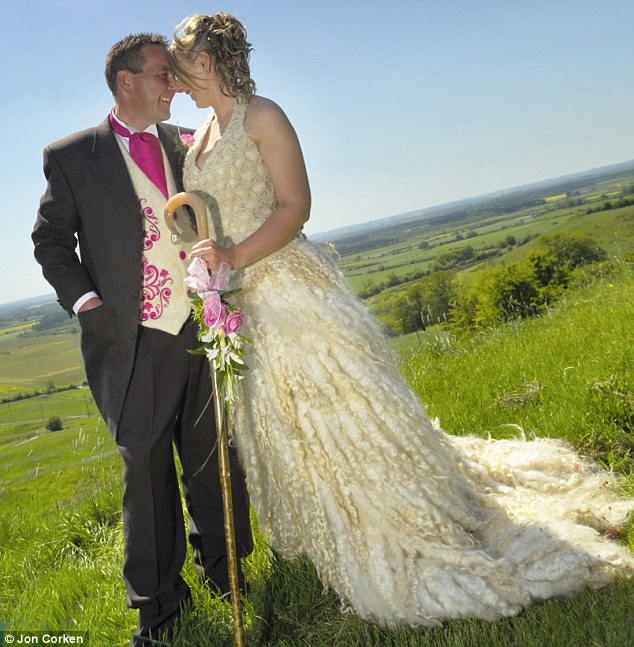
The Cotswolds sheep has what I think is a rich looking fleece with long, lustrous locks of curly ringlets. It is classified as a coarse fibre, but that just means it has a larger diameter than, say, Merino which is a fine fibre. But coarse is a description, not a comment on quality. A better description is that it is a longwool, and that, it is, measuring 6 - 12" in staple length. The locks are often sold as Santa Claus beard.  If you are making something that needs to be hard wearing, a rug, or a tough outdoorsy jacket, then you want a fibre like a Cotswold. But other, more, interesting things can be made. According to Wikipedia, the fibre was often a substitute for linen and was spun and woven very finely along with strands of gold to make rich garments for priests and Kings. And check out this wedding dress done by this shepherdess in an article by the Daily Mirror.
[Photo: Wedding dress of Cotswold locks.
Photo by  Jon Corken of the Daily Mirror]
Cotswold is also known as poor mans mohair because of it's luster. So let's forget the 'coarse' description.
If the locks are prepared in true worsted fashion, that is: hand combed so that all the fibres are parallel and any nips, noils (tangles), and short fibres removed; and then spun carefully also in worsted fashion by smoothing down the fibres and making sure you spin from the cut end to the tip end so that all the tips point in the same direction, then the lustre will be maximized and those who suffer itchiness from wool will find this preparation much nicer to wear.  A woman I know who teaches spinning and who did her Master Spinners research project on spinning for tapestry yarns, found that just by altering the tips to ends or end to tip or plying one with the other or plying all tips to end, the fibre could produce a variety of lustre or yarns that reflect light differently, hence one colour, say blue, spun in various preparations gave her enough reflection variation that she could use it for the ocean and have it showing different patterns of reflected light, just like water will do.
So there we were in the Cotswolds, coming back from an unsucessful trip to Oxford Pit River Museum where the Coast Salish Blanket I had hoped to see had been removed from display for an unknown period but I digress. So there we were on our way back to my brother's place, when we saw the sign for The Wool Church in Northleach, and did a quick detour.
When the British economy was built on wool, it was the Cotswold sheep that provided riches to the wool merchants and tax revenues to the King..
Baa Baa black sheep,
Have you any wool?
Yes sir, yes sir,
Three bags full.
One for the Master,
one for the Dame,
and one for the little boy 
who lives down the lane.
Children s nursery rhyme from mid 1700's, and was also the first song
 to be digitally recorded and played on a computer.
[Photo: John Fortey, Died 1458]
And it was here in this church that some of the wealthy merchants and their families are buried  with brass plaques memorials, with their image, some with their wive and some including small pictures of their children.
Take John Fortey, woolman of Northleach who died in 1458 and left $300 pounds, a magnificent sum in those days, to the church. His brass, which is five feet long depicts his image and tells you who and what he is: with one foot on a Cotswold sheep and the other resting on a bag of wool.
But that was then, now, sheep are being raised mostly for their meat and that does not bode well for the many rare breeds of sheep found around the world...although:  on Saltspring Island, where a friend raised sheep for meat and some wool for herself, now has switched to wool sheep since the new abattoir laws in BC which means it is now more expensive to take sheep off the island to officially approved and licensed abattoirs .
[Photo: John Fortey's feet: one on a
Cotswold sheep and the other on a bag of wool]
So while the slow local food movement takes a step back on Saltspring Island, on one farm at least, the wool sheep gains.  And on the Shetland islands where Shetland sheep are raised, they have lately been left to 'rue' that is to naturally shed their fleece.  Since paying for shearing cost more than they could get for their fleece, it wasn't worth shearing.  But lately, the price of wool has risen and now the sheep are getting shorn and the farmers are making some money on wool.
So maybe the wool fortunes will return to the Cotswolds.
[Photo: Small brass of a sheep and a bag of wool]

Friday, July 29, 2011

Knitting Mecca

[Photo: Fair Isle knitting on display
in the Shetlands]
If I were a knitting fanatic or, I suppose, a serious knitter, or just a good knitter, which I am not, but if I were, then knitting mecca would be the northern Scottish Islands: the Shetland Islands, Fair Island. Think Shetland lace, wedding ring shawls, FairIsle Knitting with multi colours And, of course, knitting meccas need fibre, lots of it, and spinning techniques designed to use the best characteristics inherent in that fibre. So knitters and spinners should head north to those islands.
[Photo: Knitted lace, with wool
 spun thinner than thread]
The Shetland Museum is a modern museum where many objects, too many to display, are also accessible in pull out drawers or pull-out wall displays. The museum, thoughtfully, provides lightweight plastic stools, useful when you just need to sit and gaze in awe for hours at a lace-knit bodice, a FairIsle vest, or try to see the ply in the cobweb yarn.
[Photo: Cathy's shawl based on a
design  of a shawl over
100 years old]
We quickly connected with a visiting spinner and weaver from California and joined her in an impromptu textile talk by two of the staff, appropriately sporting FairIsle vests as part of their uniforms.
Cathy show us a lace shawl she knitted for Cushla to wear at her daughter's wedding in New Zealand. See the picture to the right.  Cathy made up the pattern based on a 100 year old shawl on display.  No pattern, she just thought it through.
While in the Orkneys we also stopped in the small textile museum run by the Shetlands Islands Spinners, Weavers and Dyers Guild.  A small museum but someone is always there to demonstrate spinning or knitting or just to chat with you.  They have a small collection of knitting and woven goods on display.  Well worth the visit.
They told us the best quality lace knitting is done by the women of Unst.  So off we went to Unst, one of the smallest and most northerly Shetland Islands.  There we found another small museum with some exquisite knitting on display and for sale but the best pieces knitted with cobweb yarn had already been sold, leaving the very fine lace weight (and I had previously thought that was the finest until I saw the cobweb yarn).  Next door was a wonderful boat museum with a varietuy of small open boats and related gear on show.
[Photo: Unst bus shelter]
While on Unst and having done some advance reading before leaving home, I knew to look for the Unst bus shelter, the most northerly bus shelter in the UK.   Apparently the locals decorate it and each year pick a new theme and given the Tall Ships event in the islands, they picked a pirate theme.  We almost blinked and missed it but here it is.
Only a couple days after we had been, BBC did a 3 minute video on a Day-in-the-Life of the Unst Bus Shelter  The bus shelter even has it's own web site.
There isn't much on Unst but what there is is impressive.

The Perth Coast Salish Blanket

[Photo: Perth Coast Salish Blanket, photo from the Perth
 Museum web site
]
As part of my research into Coast Salish spinning techniques I arranged for access to view what is known as the Perth blanket, as it is in the Perth, Scotland Museum and Art Gallery. There is a bit of a mystery surrounding the blanket. We are not sure who collected it, from where, when, or from who. Colin Robertson a Hudson Bay employee in the 1830's, had the blanket collected for him but it is not clear who collected it.   Robertson himself never visited the Fraser River area. The packing slips for Robertson's whole collection were filled out by James Tait ???? We do know it was shipped in 1833, so we know it is probably older than that. We also know it came from the Fraser River from near what was Ft. Langley and the Snuneymuxw summer camp was  the closest village to Fort Langley