Sunday, July 15, 2012

Stories worth hearing

[Photo:Sofa without a blanket]
Every now and then you meet someone and they tell you a stop-in-your-tracks story. Here's one I think is worth passing on. We were talking about weaving and that bought up a special woven blanket that a friend Brian had acquired from his father. Brian (not his real name) made an interesting observation that it is blankets that made a house a home. Even a tarp strung up for a cover from the elements with a blanket thrown on the ground, made that tent a home.  
Brian grew up in India where his father was a missionary. While there, his father met a very poor Pakistani blanket weaver. As was customary, Brian's father bargained with him and bought two beautiful blankets. Later, Brian was given one and he loves it. It is woven in a very complicated pattern and after all these years, it is still as beautiful as the day his father bought it. Where ever Brian lived, the blanket made his home a home.  
[Photo:Sofa with blanket.
More homey?]
When his father was on his death bed, he had one regret about his whole life. Just one. After all those years, he wished he had not bargained with the weaver. He wished he had paid the full price.

Tuesday, July 10, 2012

Lost .... and found at sea

Photo, design and
decoration by Laura Landry.


Readers of the blog will wonder where on earth I have been. Well, I have been up to my eyeballs spinning trying desperately to finish all my assignments for the year. D-day (driving-day) to get to Olds Alberta for year 4 class arrived and I still hadn't finished all my homework for year 3 of the Master Spinner program. The last homework assignment (spin embroidery yarns and embroider a 3 x 3" sampler) wasn't done. The thread had been spun for months but that doggone embroidery had still to be done. I embroidered for 1,000 kilometers, followed by two evenings before it got done. So on day three, tada, of level 4 class, I handed it in. Whew!
I returned home with a suitcase full of fibre and an armload of assignment instructions for the coming year. I have been back six days and still haven't had time to unpack everything. It was the Nanaimo Dragon Boat Festival all weekend and I was on the water all weekend. 
While I was away, our team, the Vancouver Island Ancient Mariners, posted a new bra on the Newcastle Channel 'bra pole'. I don't know what the original purpose of the pile was, but some years ago, it was decided that it should be decorated by bras, so dragon boaters, while out practicing add their mark. Note the miniature graduation cap on the left cup. Nice touch!
This years festival theme was the 60's, so we went as ourselves...hippies. We paired up again this year with Seventh Wave, a fantastic team from Vancouver who went Mondrian and British. Check them out.

Thursday, June 14, 2012

Lost in TPI land

Followers of this blog may wonder where I have been for the past month. Well, I have been in TPI land, or TPI hell which is more accurate. TPI=Twist per Inch. 
The assignment: spin 10 yards of yarn at 1 twist per inch. Sounds easy right. HA! Sounds simple. Deceptively simple. Deviously straight forward. Wrong! Anything but! At 1 TPI (count the bumps along the edge of a yarn in a one inch length and divide by the number of singles making the yarn - more on this frustrating formula later) most yarns tend to fall apart. It requires a very grabby fibre but after a few frustrating failed attempts I dug out my shetland roving bought at THE Jamieson's in the Orkney Islands. Sigh, such beautiful special fibre and it seemed a waste to just throw a lot of it away in attempting this sample. But after a while I was able to do it. On to the next assignment: spin ten yards at 2 TPI. A few attempts to achieve precisely (well, I have the marker doesn't look too closely) 2TPI and on the the next assignment. Spin 4TPI. Then 8TPI, 12 and 15 TPI.  
Somewhere between 8 and 12 TPI I realized I did not know how to count TPI. Seems silly, given my formula above but when your attempts to achieve these assignments, especially the higher TPIs do not work, then you start to question everything. Ergo: how do you count bumps? Just the bumps on one side of the yarn, or both sides of the yarn. One side it turns out is correct. But then somewhere between 12 and 15 TPI I forgot to divide by the number of plies. It seemed impossible to spin at 30 bumps per inch but 15 bumps more doable. At this pint I was producing unusable yarn with so much twist one couldn't use it for anything but a rats nest. Hence I was questioning all the instructions. They didn't work.
Then there are the questionable formulas to figure out how much twist to put into each single (this involves length of draft or fibre between you and the wheel, your wheel ratio (how many twists each time the wheel goes around) and how many times you let the wheel turn per draft. I double checked the formulas, yes, they were correct. Then how come my yarn turns into a hopelessly tangled twisted knot? This went on for, I am ashamed to admit this, but 3 months of cursing and spinning junk! So that is where I have been. TPI hell.
The solution turned out to be all in the fibre. Selecting the right fibres for the job was critical. Spinning to the crimp (think curls, waves, in a fibre) worked for the medium TPIs but at the extreme end, one needed to think and select carefully. Silk, for example is much easier to spin at 15 TPI than wool. Take my word for it.

Saturday, May 19, 2012

Learning to knit - it's the other stuff

I am now well into (month three?) project #2 - a 'shawlette' -- a mini shawl which I thought would be a perfect project. Not too big. Not too small. Not too artsy. Not too plain. Not too hard. Just right, wearable and useful. That was the theory. I picked the 'Holden Shawlette' from Ravelry, one of the most popular ones and suitable for the beginning intermediate knitter.
I saw I am well into the project, meaning I have now ripped it back four, 4 four! times. But, on the positive side, I am beginning to 1) understand the pattern and 2) am beginning to understand what learning to knit really means. It does not mean learning to knit and purl....well, okay, it includes that but, it really means knowing:

  • what row you are on!
  • what side you are knitting, the front or the back
  • how to unravel
  • why, when and how to use stitch markers
  • how to keep the stitches on the needle
  • how to count stitches
  • how to fix mistakes
  • knowing when good enough is good enough and when it isn't!
[Photo: Note the use of paper clips
 as stitch markers!]

Thursday, April 26, 2012

What are the chances?

I am delighted with a new gift. A friend from the University Art department (the one behind the doily bombing, see this post) and some innovative yarn bombing is retiring and cleaning up her condo. I ran into her the other day and she said 'you like spinney things don't you? I have a thingy with 3 spinney thingies with whorley thingies looking for a home.'
I had no idea what she had but was happy to receive these mysterious thingies.
We met today and she presented me with the thingies saying 'I have no idea of what they are.'
But I did!
[Photo:Indian Head Spinner on
Singer sewing treadle machine]
What are the chances? They are 3 bobbins the perfect size for an Indian Head Spinner (aka Country Spinner, aka Cowichan Spinner, aka Salish Spinner, aka Squamish Head Spinner). And they are stored on a lazy kate. Not only did I recognize them, I have an Indian Head Spinner needed to use them! See my earlier post on my Indian Head Spinner. What are the chances?!


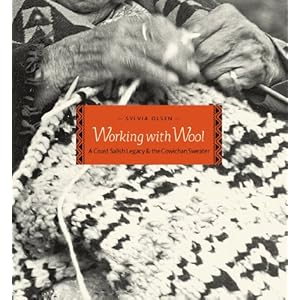
This book Working with Wool, a Coast Salish Legacy is an excellent history of the Vancouver Island Coast Salish wool industry.

Wednesday, April 11, 2012

Just like dinner

Stephanie from Knotty by Nature showed off her elegant silk shawl at the 25th Annual Island Weaving and Spinning Retreat in Parksville. The warp and weft are handspun silk. Stephanie was challenged when someone told her you can't use silk singles for warp. So she set out to do just that. She dyed the silk by, err, umm, mistake but the colours are subtle, harmonious and beautiful. It took her a year to spin the yarn and a week to weave it, 'just like dinner' she said. Think about it.

Friday, April 6, 2012

A lifeline

[Photo: The red yarn is a well used life line.]

frog

v.
to unravel a knitted garment. Also frog stitch v., to intentionally rip out a seam, and 

n., 
an intentionally ripped seam.


un·rav·el

v.
1. to separate or disentangle the threads of (a woven orknitted fabric, a rope, etc.)
2.to free from complication or difficulty; make plain or clear;solve: to
unravel a situation; to unravel a mystery.
3.Informal . to take apart; undo; destroy (a plan, agreement,or arrangement).
4.to become unraveled.


rav·el

 v.
1.to disentangle or unravel the threads or fibers of (a wovenor knitted fabric, rope, etc.).
2.to tangle or entangle.
3.to involve; confuse; perplex.
4.to make clear; unravel (often followed by out ).
5.to become disjoined thread by thread or fiber by fiber; fray.
6.to become tangled.
7.to become confused or perplexed.
8.(of a road surface) to lose aggregate.

Note to self: funny how there are three words used to describe ripping out (there's another one!) your knitting, and only one for knitting up.


frustration

 n.
1.the condition of being frustrated
2.something that frustrates

3. to become unraveled (okay I put this one in here, but it does fit).  See ravel, unravel and frog.


life-line

 n.
1.a. An anchored line thrown as a support to someone falling or drowning.
b. A line shot to a ship in distress.
c. A line used to raise and lower deep-sea divers.
2.a. A means or route by which necessary supplies are transported.
b. One that is or is regarded as a source of salvation in a crisis.
3.A diagonal line crossing the palm of the hand and believed to indicate the length and major events of one's life.
4.a length of smooth waste yarn which is inserted through the sts of a row or round of knitting using a darning needle, usually while working a complicated lace pattern. If you make an irreparable error and need to rip back, the lifeline provides an easy point to rip back to, and ensures that you will not lose any stitches.


re·lief

 n.
1.alleviation, ease, or deliverance through the removal of pain, distress, oppression, etc.
2.a means or thing that relieves pain, distress, anxiety, etc.
3.money, food, or other help given to those in poverty or need.
4.something affording a pleasing change, as from monotony.
5.release from a post of duty, as by the arrival of a substitute or replacement.
6. a feeling of relaxation after tenseness when you can take the life line out without having used it.  (okay, another one I added)