Monday, December 28, 2009

Salish Spindle Whorl


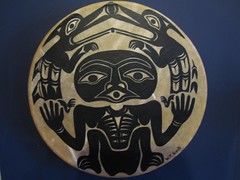
It has been a busy Christmas season, hence a lack of blogging. However, we purchased a special item this year, a drum made by Richard Aiscaican who makes superb drums. His attention to detail marks him as a master drum maker. Check out the photo of the sides and back of the drum where you can see the patterns created from the even application and pressure between the sinew and the drum skin.

The image on the drum is painted by Joel Good a Snuneymuxw member. It is based on a Salish spindle whorl, a crouching naked figure (needing warm fabic?) with two sea serpents wolves facing each other at the top (edited to reflect Joel's correction -thanks Joel). This is from the Snuneymuxw creation story. Apparently sea serpents are more common in the Nanaimo area than elsewhere. The mouth of the human would be where the spindle shaft would be inserted.
Below is a picture of a similar whorl design from the Canadian Museum of Nature. The Snuneymuxw First Nations Band Council uses the spindle design as a logo as can be seen in the photo of the Band Office window on the web page describing spindles.


Sunday, December 13, 2009

Coast Salish Wool Dog - What did it look like?


As promised, I am adding answers, or at least more information, about the Salish wool dog as I find it. So what did it look like? In Paul Kane's painting "A Woman Weaving a Blanket" now at the Royal Ontario Museum, he paints a small white dog, almost poodle like. However, the painting is based on some sketches and his sketches of dogs look different.


Susan Crockford, an expert in archaeological analysis of bones, has done extensive research on the indigenous dogs of the Pacific Northwest Coast, has a sketch on that accompanies her monograph on 'Osteometry of Makah and Coast Salish Dogs' that, knowing her expertise, is probably a good likeness (the dogs on the right).


On a side note, on the Snuneymuwx First Nations web site, the Salish Spindle is discussed, and they mention that Cameron Island was one of the islands used to keep the Salish Wool dog breed separated from other dogs. This makes sense as Cameron Island (which is no longer an island) is very close to where the Solexwel village was, allowing easy access to care and feed for the dogs. There is also on that page, a close up of a diorama that shows two dogs, that may be more accurate than the Paul Kane painting. These dogs also look like the sketch on the right.

Thursday, December 10, 2009

The oldest known fibers in the world

The oldest known spun fibers in the world has been found in a cave and they are dyed black, grey, turquoise and pink AND they are over 30,000 years old! Here's an article on it.


Image of microscopic fiber samples courtesy of Science/AAAS

Tuesday, December 1, 2009

Totem Raising and unveiling


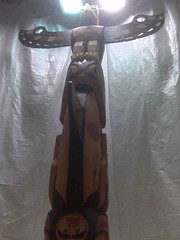
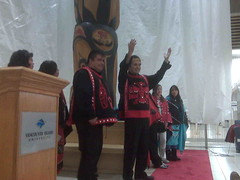
A Totem pole was raised this week at VIU in the library. I am not sure how they got it into the library and then raised once in the building. An amazing feat of engineering. Apparently there will soon be a video showing how they did it on youtube. I'll link it when I find it.


Gary Mason performed a ceremony and Jimmy Johnny the master carver told the story of Thunderbird and Killer Whale.

Sunday, November 22, 2009

S'abadeb - The Gifts

Cedar, cedar bark, paint, abalone shell and operculum shell
Private Collection


Barbara Brotherton, curator at the Seattle Museum of Art, and the curator of S'abadeb exhibit at the Royal BC Museum gave an interesting talk today. It was a very informative introduction to the exhibit. If you have a chance to see it, do.  

S'abadeb is a Lushootseed term for gifts and conveys the theme of reciprocity of giving and receiving gifts. Gifts both tangible and intangible such as songs and names.
I was lucky enough to have a few minutes chatting with her about Salish spinning, weaving spindle whorls and the wool dogs. She said that George Gibbs, a surveyor and a witness for the signing of the Point Elliot Treaty 1855 in Washington State, was given a wool dog 'Mutton' (he, that dog that is, liked to chase sheep) whose pelt was given to science and currently is in the Smithsonian Museum. She also mentioned a man who claimed he had a dog that was genetically very similar, a Japanese breed.  
My mother mentioned that when she worked with the BC Lands Title Office, where she often had to refer to surveyors records (organized diaries) she thinks she read that an island/s off Gabriola (Flat Top Islands?) was used to keep the dogs separate from non-wool dogs. 
So there are a few tips to follow up on. 
Googling, I came across an article,  'Wolly Dogs' by Elizabeth Flower Anderson Miller who has obviously researched this topic in detail. She suggests that the wool dog is the result of the recessive gene which causes the soft down hair (wool) to grow longer than the guard hair -- the Malamute factor, a lethal flaw for dogs that need to survive in very cold climates where guard hairs are needed to shed water, sleet, snow and ice. However, for the Gulf Islands/Salish Sea area, where snow rarely lasts two weeks of the year, this factor wouldn't be so lethal, rather it would provide much valued thick, long spinnable fibre. I'll do up a blog entry just for questions and answers about the Coast Salish wool dog.

Tuesday, November 17, 2009

Coast Salish Woven Fabrics - More questions than answers


I am curious to know more about traditional Coast Salish woven fabrics, especially those collected pre 1830s. Coast Salish weavings can be incredibly complex. Techniques include twining (double, simple, three-strand), openwork, overlay, tapestry and twill. Some of the patterns were very intricate and made of fibres from dog wool/hair, nettle and mountain goat wool. There is even reference to one that included down. 
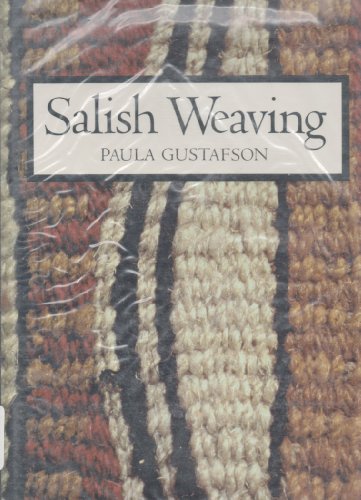
Paula Gustafson in her book Salish Weaving writes that she has examined most of the blankets in North American museums and has only seen one of dog hair. So how come so many descriptions and records of wool dogs by some of the early explorers of the area? And where are all these rugs, blankets and other fabrics made from dog hair?

Grant Keddie, from the Royal BC Museum tells me that UVic is getting an electron microscope and there is an expert there is working on analyzing the hairs to try and figure out if they are goat, dog or a mixture. He suggests it is time to re-examine some of these treasures using newer technologies to help solve some of these mysteries. Grant has been interested in the wool dogs for a long time (see Keddie, 1993, Prehistoric Dogs of B.C. Wolves in Sheep Clothing, the Midden, 25 (1)3-5, February. Grant is currently researching the history and use of Coast Salish spindle whorls. He also tells me that Susan Crockford is the local authority on doggie DNA and included archaeoloigal material from RBCM collection and Tatlan Bear dogs in her research. Check out her books and publications. And here is an article on the wool dog.
Some of my questions:
  • What was the Salish wool dog? What did it look like? There is one painting by Paul Kane but is it an accurate likeness? Were wool dogs found up and down the coast of North America? Is there similar breed still in existence? What type of fibre was it? How long, how thick and how much crimp did it have?
  • Many of the blankets were made from mountain goat wool. I don't think mountain goat existed on Vancouver Island, so they must have traded for it. So how common was weaving if the wool came from dogs or mountain goats. Was there enough wool to make this a common activity or a rare activity? If it was common, well, that's a lot of mountain goat and a lot of trade. Was there enough mountain goats? Or was dog wool more common? If weaving wasn't common, then that could explain why there was such value placed on blankets. But then, what was the common fabric?
  • Where did the dye colours red, blue and black come from?  Yellows, tans. browns, oranges, greens come from a variety of possibilities (eg. wolf moss, oregon grape roots, alder bark) but a good black (salty mud?), blue or red (can alder bark really get the traditional reds?) is hard to come by.
Feel free to post any answers.
Speaking of the Royal BC Museum, they have a great exhibit which opens on Nov 20th. S’abadeb – The Gifts: Pacific Coast Salish Art and Artists. 


Edited to add a couple of related books.
Here are a couple of books you might be interested in: 
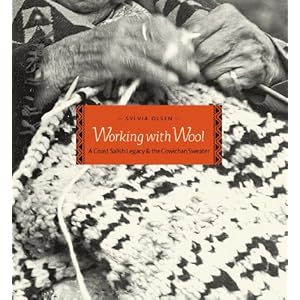
Working with Wool, a Coast Salish Legacy . Although it looks at the history of the Cowichan Sweaters, it covers the history of the wool too. And Paula Gustafson's Salish Weaving .

From the Bizzare world of Knittied Nerds - frog dissection


Here's an interesting knitting project - dissected frogs and rats!. Check out the Knitting 101 Photo Gallery from Discovery Magazine. here's a rat in the dissection tray and here's a frog. These are made by a student who is trying to make a living from her art. Help support her. Check out her Crafty Hedgehog Etsy store for more bizzare creatures.