Friday, January 21, 2011

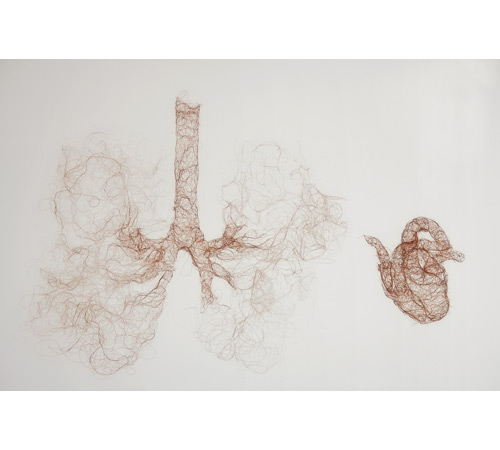
Knitting from the heart, err, colon.

[Photo: untitled (heart lungs)
2007
knitted human hair
courtesy, private collection, sydney
photographs: danny kildare]
You have to admire this knitting!  I mean, look at it.  First, the idea of knitting underwear is a little far out but a, well, an intestine, a colon, lungs even, now that is different! And after the shock of the idea comes the realization that these objects d'art  are knitted (stocking stitch if you are curious) with ...better sit down for this... human hair.  Artist Helen Pynor even confesses 'It's an act of madness'.
[Photo: Underneath 2007
knitted human hair, courtesy, private collection, paris
Photo: danny kildare]
Thinking about the women who wove their lives into the Afghanistan rugs (see the blog of Dec 26th) certainly connects you in a much more meaningful way to their work, but think about knitting the hair of many women into something. say a colon, is a whole new level of meaning between the shorn women and the knitter.  Read more about Helen Pynor at her website: http://helenpynor.com

Monday, January 10, 2011

Distaff Day in Duncan

[Photo: Pat's home grown linen and Iris leaf
place mats done for the Salt Spring 100 mile
fibre challenge]
Apparently, the first day after the Twelfth Day of Christmas (January 6th) is known as Saint Distaff Day (January 7th). A distaff is the tool spinners use to hold long fibres, usually flax/linen, while the fibres are spun. Distaff Day is the day spinners would pick up the distaff and start spinning again after the holidays. Consider that in the hey day of St Distaff's Day, i.e. when most people knew what a distaff was, most women were occupied with spinning. Hence, Distaff Day is the perfect excuse for a bunch of spinners to congregate and spin and spin and spin.
[Photo: Yarns dyed by local
 mushrooms]
[Photo: Anna's lace
 twist socks]
The Tzuhalem Weavers and Spinners Guild host a spin-in on this day which was attended by people from Deep Bay to Victoria. A gathering of spinners. Never, in my early years, did I ever imagine that I would be found spinning all day with a group of women. But it was fun! We went around the room, each person introducing themselves and doing a show and tell, followed by spinning, then pot-luck lunch, then spinning and chatting. Such a good way to meet people. For others it was a great way to reconnect.
What St. Distaff Day has to do with a saint, I have no idea. There doesn't seem to have been a saint called Distaff or a saint associated with Distaff Day...although many women are unacknowledged saints.
The Victoria Guild contingent,
4 women, 4 spinning wheels and a ton of fibre.

Sunday, January 2, 2011

New Year, Old Spindle

[Photo: Spindle whorl found at L'Anse aux
Meadows, Newfoundland.
Image from: http://www.pitt.edu/~dash/whorl2461.jpg] 
This spindle is a most unusual spindle, one that tells a story and proves a story.  The picture on the left is the Norse spindle whorl found at L’Anse aux Meadows in Newfoundland.  This is the oldest spindle whorl to be found in Canada and is over 1,000 years old.  According to two Icelandic sagas that talk about the Viking settlement at Vinland (now proven to be L’Anse aux Meadows, Newfoundland), this spindle probably belonged to Gudrid (aka The Far Traveller), wife of Karlsefni, and mother of Snorri, the first European baby to be born in North America, and my great-great (27 times great) grandmother.
In 1960, Helge Ingstad and his wife Anne Stine Moe, an archaeologist looked for and found the Vinland of the sagas in Newfoundland. The site also proved that the Norse people had been to North America 500 years before Columbus.  It was the whorl (along with a knitting needle) that helped confirm that this location was indeed the Norse settlement that until then had been the Vinland of two Icelandic sagas. The Greenland Saga and Eric the Red Saga, which both spoke of Gudrid having lived in Vinland twice and the second time for three years where she gave birth to Snorri. At that time, only women spun hence the whorl indicated that a Norse woman had been there.  Gudrid was not the only woman to have been in Vinland, from the sagas we know that Freydis also lived there for one of the voyages.  She too most likely spun, but since Fredis had a reputation of being ferocious and a bit unlady-like, I like to think that this whorl belonged to Gudrid.
The whorl is made from soapstone and is very similar to the ones seen at the National Museum of Iceland in the picture here.


[Photo: Icelandic spindles in
 the Icelandic National Museum]
Eva Anderson in her dissertation research on Viking era textile production confirmed that the whorl weight and diameter of the whorl determines the rate and duration of the spin, the amount of tension and hence, the fineness or thickness of the yarn spun.  Often various whorl sizes would be found close together in Norse archaeological sites which reflect the variety of spindle tools needed for the variety of textiles produced.  From Norse archaeological sites, whorl weights range from 4-100 grams with 5-29 g being typical.  Whorl diameters range between 5-45 mm and the height of stone whorls is 5-20 mm, with a 7-12 mm hole.
The shafts of that era were almost always thinner at both ends and thickening in the middle.  Shafts would typically be 98-215 mm in length, with diameters from 5-13 mm, with 7-8 mm diameter most common (Andersson, 1999). 
In the museum (see the picture above) the spindles are displayed with the whorl at the top, but they were probably used as bottom weighted whorls.

See also:

Tuesday, December 28, 2010

Yes Mum. This is MY blog

Mother,
from the book by Judy Olausen
Almost a year ago, I put a bookmark/favorite shortcut on my parents computer to my blog. I figured it was a good way for them to see what is going on and keep in touch with me. I thought this would be of interest because 1) I am their daughter and 2) my mother also dusted off her spinning wheel and loom after letting them languish for 20 years and fibre is once again addictive. I must admit she didn't seem as enthralled as I thought she might be, mothers always being enthusiastic about the creative attempts of their offspring. But I passed it off to a boring blog post that day. That or an honest response to 'oh no, not another self-promoting or let-it-all-hang-out-there diary/blog'.
My mother phoned yesterday to say, with surprise in her voice, that's YOUR blog. Yes, Mum, this is MY blog. Bored while waiting for a web page to load, she decided to try the bookmark thinking it might be more interesting than a s.l.o.w.l.y l.o.a.d.i.n.g. page. Of course this was before she actually realized it was a link to MY blog. I guess my readership hit numbers will now double.
P.S. I always like to include a photo, so I thought of a wonderful book that came out in 2000, Mother by Judy Olausen, in which her photographs depict her mother as the quintessential mother of the pre-women's liberation era. The cover photo here is titled 'Mother as Coffee Table'.

Sunday, December 26, 2010

Afghanistan, rugs and Christmas

I received an email from my brother recently who is now in Afghanistan and there, in all that chaos, he had the time to read my blog ---he's probably reading it right now. Imagine that. Hello Bro'!--and inspired by fibre, he sent along a link to an article about the rugs of Afghanistan which had a lovely quote which he quoted and I in turn quote him quoting the article. "Read this: http://www.huffingtonpost.com/seema-jilani/the-carpets-of-afghanista_b_718812.html  - I especially like her description of what to do with an Afghan carpet: 
The rug is not just for you to place in your living room, or to be trampled upon by high heels at a cocktail party while people swirl martinis. Women have sewn their lives into it. They have whispered about their husbands, gossiped about in-laws, and exchanged riveting hopes and dreams while their fingers diligently worked the loom. Take your shoes off and don't tread heavily. Respect their stories." 
Spinning on the ferry as we came through Active Pass
to Victoria
 Doesn't that make you think twice when stepping on a carpet?! And imagine thinking about rugs and weaving while serving in Afghanistan.

Christmas travel spinning 
Here, we visited a our families over Christmas, we took the ferry to Vancouver to have Christmas Eve with the in-laws' then the ferry to Victoria to have Christmas dinner with my family. With so many ferry rides and the time spent in the car gave me productive homework time.
We missed my brother (and his family, who are in England), at Christmas and we watched the Canadian troops celebrating Christmas in Afghanistan on the news. We didn't see him but then, maybe he was busy reading this blog.

Thursday, December 23, 2010

Homework - am I there yet? NO

Homework, as far as the eye can see...
I have been busy lately...and stuck in the colour wheel assignment ...but I have lost track of where I am and how far I have to go. Let me sum it up...a looooong way! As panic is starting to set in, I thought I better get on top of where I was so I stacked everything up on table, organized the assignments into three categories: Finished (i use that term loosely), halfway there and still to do. Then I counted: 9 items done, 9 half way done and 22 still to go!
And this is just the actual spinning, then there are the written assignments, the 10 book reviews and the spinning major 25hour project.
Then I figured out how many days to go -- 109 days. Well, that's not so bad. It's still possible. Maybe I will have time for Christmas baking.
On the left: done; Centre: half done; Right: kits waiting for action.

Saturday, December 18, 2010

Lost in a colour wheel

You might be wondering where I am with my Master Spinners homework. Well, I am stuck in a viscous circle - the twelve colour wheel circle. It is not hard, nor boring, nor tedious, it is just taking time. The assignment: Create a colour wheel. It requires weighing each colour, then blending colours equally by weight, then spinning them and finally create a colour wheel. Here's how it works: take three primary colour merino roving - yellow, blue and red. Blend each of the primary colours with another primary to get three more colors, eg. red + blue = violet. Keep in mind that the new blend has to be homogeneous - blended very carefully, striped colours will be rejected. So I card very careful using the drum carder, running the new blend through the drum 3 - 4 times. Then take the new colour (or, figure out the correct portions of the primary colours that produced the new colour and add to it to et the new colour - you can see where this is getting confusing) and blend with the primary on each side eg. violet + blue = violet/blue, violet+red= ...hey wait a minute, what does that make and where is it? Excuse me while I card more wool....