Thursday, May 19, 2011

THE Hill - The centre from which Canada revolves

[Photo: A rodent - marmot?]
I am in Ottawa for a few days, so I tried to make the most of it. By coincidence the city had just installed Bixi's - bicycles for rent. When hoofing it back to the hotel I came across them and was inspired to rent one. $5 for 24hrs. A cheap way to circle round THE hill. I immediately headed across the river to the Canadian Museum of Civilization (scouting the route for a visit there, with the curator who specializes in Coast Salish textiles, the next day - more on this later), along the river bank, back across the river, along THE Hill, up along the locks and parked the bike back in its stall. Interestingly, I saw more wildlife (of the animal variety) than I expected. First ducks in the locks (not sure how they get out since they need a flight path of a certain length and those locks look short), some sort of a rodent (parliament must be inundated with them), a family of Canadian (well, this IS the capital) Geese and a bloody big fish that surprised many passer-bys.
The Bixi bike was great fun. Since you can park it in any Bixi location, I ended up picking up another one the next morning (remember, $5 for 24hrs!) for my visit to the Canadian Museum of Civilization, parking it there, and picked up another one for the return trip.
I had time for a visit to the National archives where I came across a monument with a thought provoking quote which is a good way to end this posting:

Saturday, May 14, 2011

Tierra the wonderdog

[Photo: Tierra and her brood of eight - less than 8 hours old] 
Readers of this blog (all three of you, plus my mother) will remember Tierra, the kayaking wonderdog who was stolen and rescued by accident (click here to read that story). For those who are new to Tierra, she is a labradoodle who has some of the best doggie adventures as part of the mis-adventures of her owner Trudy, including kayaking to town and back everyday--although I am not sure if this is classified as an adventure, it being a daily activity.
[Photo: Tierra and her many foster parents]
Tierra has always LOVED little toys that squeek. To Trudy, this was an indication that Tierra was destined to be a mother, so a date was arranged with a distinguished poodle. At a party at Trudy's, three of her close friends wondered about this pregnancy and knowing Trudy, we just KNEW that something would go awry. The question was what. A sense of joint ownership of Tierra made us try to predict and prevent any possible hiccups in this process. The question was raised 'how long is a dog pregnancy?'. Page 25 of a convenient doggy breeding book told us....' the average dog pregnancy is 63 days, although they can be anywhere between 58 and 68 days.' I looked at Denise and laughingly suggested that Trudy would probably be away at the critical moment. When Denise mentioned it was a distinct possibility as Trudy was going to be on a boat in the Queen Charlottes sometime in May, we knew this was the hiccup. Trudy, passing by with a tray of cheese and crackers pooh-poohed that suggestion. She would be home on day 61 a few days ahead of the due date and Ian would care for Tierra until she got home. I looked at Denise and Denise looked at me and we knew!
Today is day 58 and look at these beautiful puppies. They are perfect all eight of them! Trudy, as far as we know is somewhere off the coast out of cell and email range.

Tuesday, May 3, 2011

Spins with wolf

[Photo: Samoyed dog on the left
and wolf on the right]
I recently had an opportunity to spin both wolf and dog (Samoyed) hair at a workshop with Judith McKenzie. I will do a separate post for the dog hair as there is so much to say about it and for now focus on the wonderful wolf fibre. The wolf was a dream to spin. You would think wolf has more rigid hairs and hence a rougher feel to it but the down from its coat is so soft it gives it a silky softness and it has a halo like mohair. The dog in comparison is soft as well but has a firmer feel and lacks the silkiness of wolf.
Interestingly, wolf doesn't smell like, well, like wolf. Dog, on the other hand, smells like dog. One wants to make sure that smell is vanquished completely from the fibre long before being caught out in the rain wearing a dog sweater.
[Photo: Wolf on the top and dog on
the bottom]
Judith and her wolf spinning friend Debi (who was also in the workshop) had collaborated on a chock-full-of-information-for-the-wolf-wannabe-spinner-in-all-of-us article on spinning wolf for Spin-off magazine (Fall 2009) and the whole class benefited from their incredible knowledge. Here's the short version: make a cloud of fluffy fibre; spin semi-woollen; wash vigorously to bloom and lock the fibre; luxuriate in the softness.
Where does one get wolf to spin? Well, I suppose you could hope to find natural shedding of their winter coat out in the wilds, but it is a better bet to try zoos, captive wolf sanctuaries, owners of wolf/dog crosses and ambassador wolf programs. Check out this story about an ambassador wolf.

Saturday, April 30, 2011

Island Rainbow

An amazing rainbow this week. It covered Protection Island. Of course it was even better than this picture portrays.

Sunday, April 24, 2011

Tribal Textiles

[Photo: Judith's tribal rugs from Africa]
I've just come back from a wonderful 4 day workshop on Tribal Textiles taught by Judith McKenzie. Judith taught me spinning 25 years ago, so it was a wonderful way to reconnect up with her. So much to spin, so much to tell. It will take me a few postings to even begin to convey what was covered and the sense of adventure that went along with it.
It was held in the dead centre of vampire country apparently. One needs to be a female teenager or a vampire devotee to understand that the small town of Forks, Washington is the setting for the Twilight Series of books and movies about vampires, werewolves and teenage angst.
[Photo: Amy and Judith at the treaty line
(between the werewolves and the vampires)]
Vampires aside, we spent the four days learning from First Nations (Makah, Quileute, Salish), touring the Makah Museum at Neah Bay and behind the scenes at their storage facility, hiking to Cape Flattery, walking the beaches at La Push,working with cedar, Salish weaving and coiling, spinning, spinning and spinning, and, on one occasion howling at the moon.
Here's a list of fibres we spun or wove:
Texas mohair/wool - thigh spinning, Hemp, Hemp and feathers, hemp and down, Dog hair, Dog hair and feathers, dog hair and down, Wolf/wool, Bison/silk, Bison/wool, Cotton, and Cedar.
I'll try to do each one justice in later postings.

Wednesday, April 13, 2011

Play and Kumihimo

[Photo: Alison Irwin's 'O is for Ocelot'
Kumihimo braids]
When I think of the word play, I think of it having two purposes.  There is playful play, where you play around with something trying to learn 'it', to understand 'it', to be able to do 'it' (say, learning to play the piano).  There there is the powerful play, where you know 'it' so well, you have complete mastery and control that you can play with 'it', make 'it' do whatever you want (like composing new songs).
[Photo: My first sample, showing  various
geometric patterns, from the tip: a spiral, rake,
dark diamonds and lightning]
  I especially love it when someone takes a craft or an art form and plays with it,  gets to know it, tries this with it, tries that with it, really understand it and is able to create new forms, new uses, new functions, new knowledge of 'it'.  The 'it' in this case Kumihimo and the player is Alison Irwin who taught a group of us her Eight 'n Eight Kumihimo workshop - eight light threads and eight dark threads used to make 'Kongo Gumi' (hollow round) braids. A day inspiring me to want to play.

Thursday, April 7, 2011

The Coast Salish Spindle

[Photo: Coast Salish whorls at the
Royal BC Museum]
I have been spending some time investigating the Coast Salish Spindle with the idea of having a friend make me one and thought I would share some of what I have found. 


The Coast Salish spindle was used mainly by the Coast Salish of Vancouver Island (e.g. Snuneymuxw , Quwutsun, Tsartlip) and the mainland Coast Salish (e.g. Musqueam, Yale, Spuzzum). The Coast Salish Spindle is distinguished from other spindles, not only due to its size: the spindle shaft usually measures 90-120 cms (35-48”) and the whorl is commonly 18-20 cms (7-8”), but also due to its method of use –tossing into the air (more on this in a later blog...once I have had a chance to figure out how that worked).

The whorl, often made from Maple wood (have you ever seen those beautiful Maple trees in Cowichan Bay?), is placed either midway up the shaft or between half-way and two thirds down the shaft. The shaft is tapered with the larger end at the bottom. The whorl is often decorated by incised carving on one side of the whorl, the side facing down towards the spinner. The upper side of the whorl is sometimes flat or slightly concave. On many whorls the center shaft hole is thicker than the surrounding wood, tapering down to a thinner outer edge of the whorl.

[Photo: Salish spindle on display at
the Royal BC Museum]
The Salish spindle was used for spinning goat wool mixed with dog hair from the Salish Wool Dog. The yarn created was a thick yarn used for blankets. Later the spindle was used for yarns used in the Cowichan sweater industry.


There are a few things about this spindle that I find intriguing: its size; the way it is held; the method of tossing and turning; the use of a tension ring to add the tension to the drafting process. Intriguing enough to try to recreate one and to try it out. I will let you know how it works.
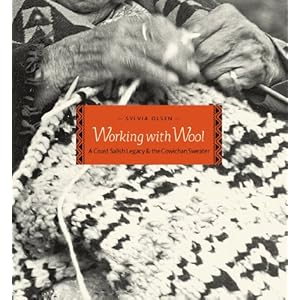
Edited to suggest a great book on the history of Salish Wool and sweaters:
Working with Wool, a Coast Salish Legacy . Although it looks at the history of the Cowichan Sweaters, it covers the history of the wool too.